ShelfSpace Live guide

Step-by-step guide

ShelfSpace Vendor Guide

How to see your sales and get paid -- one screen at a time.

Getting Started

Start here. This chapter gets you signed in and shows you where your money and your sales live before the role-specific chapters below.

Sign in and get your bearings

You reach ShelfSpace at ourshelf.space and sign in with your work email and password. For security, we send a one-time code to your email to confirm it's you before you're in. Once you're in, the dashboard is your home screen.

1

Your dashboard at a glance

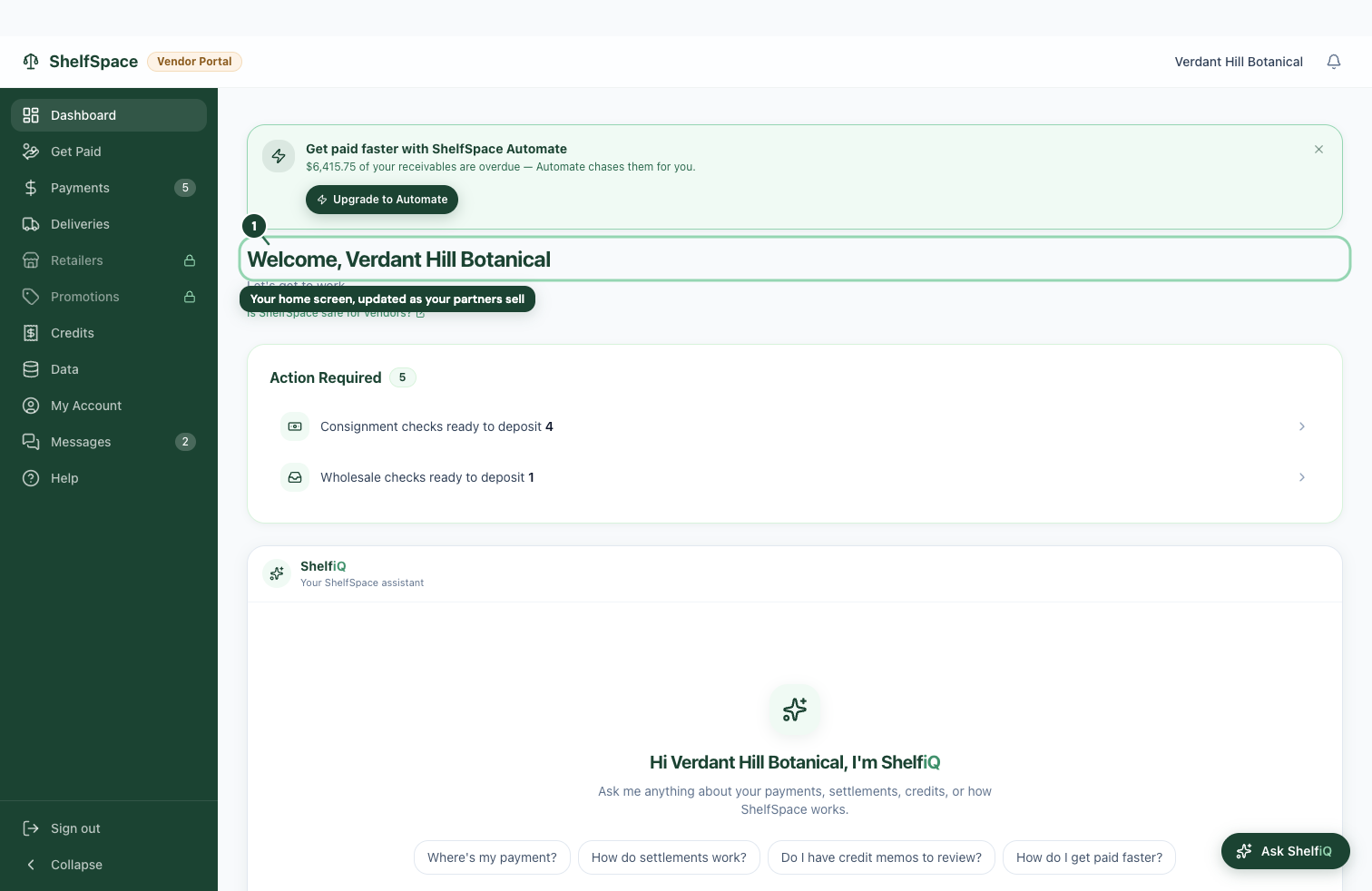
Your home screen, updated as your partners sell
1Your home screen, updated as your partners sell
The dashboard is your morning check-in. It surfaces what needs you first -- checks that are ready to deposit and credit memos waiting for your reply -- so you can act on your money without hunting for it. Handle the items here, or use the green sidebar to jump straight to any screen. Everything updates on its own as your retail partners sell your product.
2

Find your way around

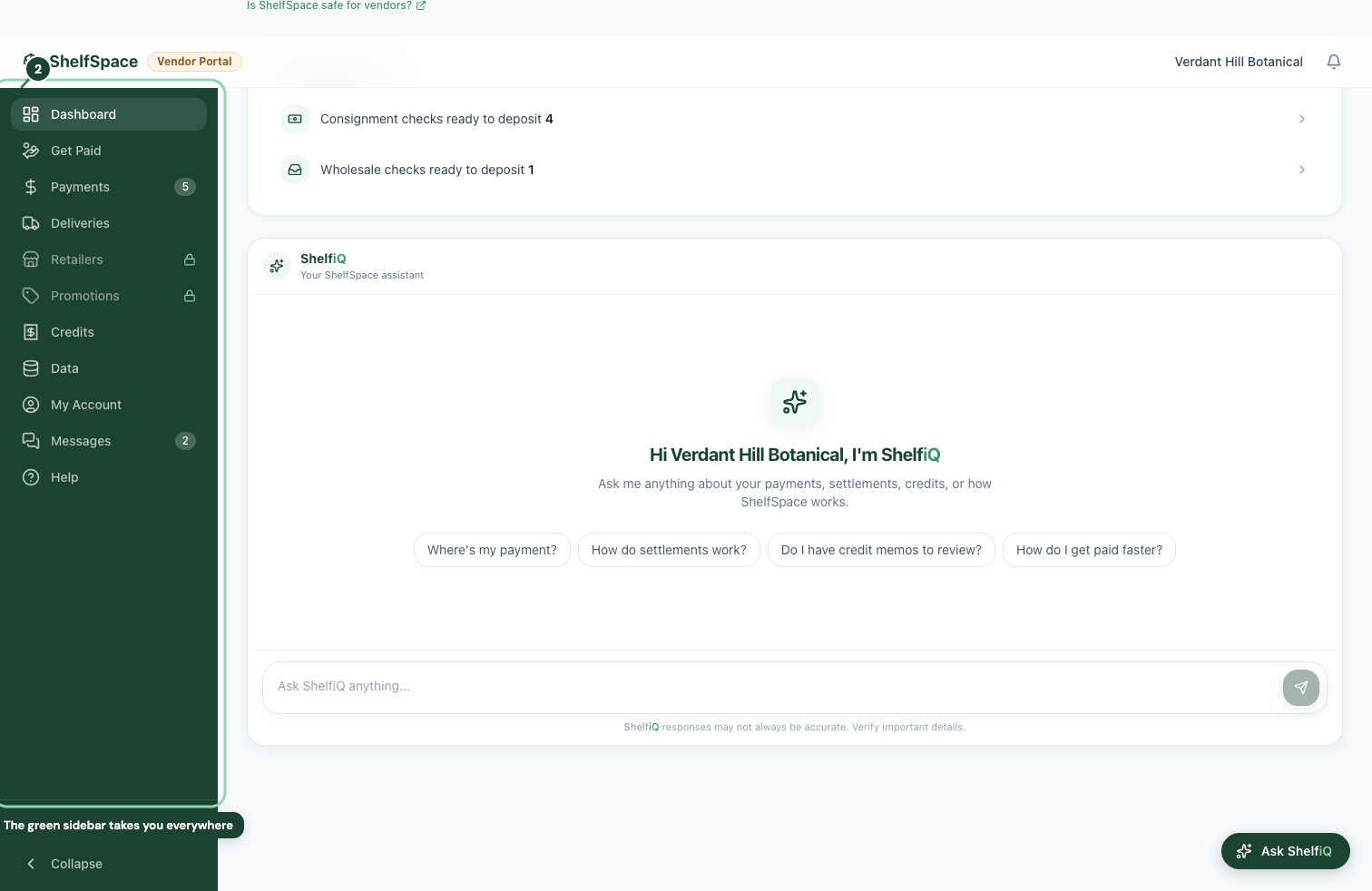
The green sidebar takes you everywhere
2The green sidebar takes you everywhere
Every screen is one click away in the green sidebar on the left. Payments is where the money your retail partners owe you lives -- your settlement payouts, your checks, and each one's status. Get Paid is a separate tool for billing your own buyers and following up on what they owe you. Credits holds the credit memos and monthly statements your partners send you, Deliveries shows what you've shipped, and Data is your sales and product detail. My Account holds your business details and bank setup, and Help is there when you're stuck. The sidebar stays with you on every screen.

Get help when you need it

Stuck on something? Help is one click away, and a real person answers.

3

Guides, videos, and a real person

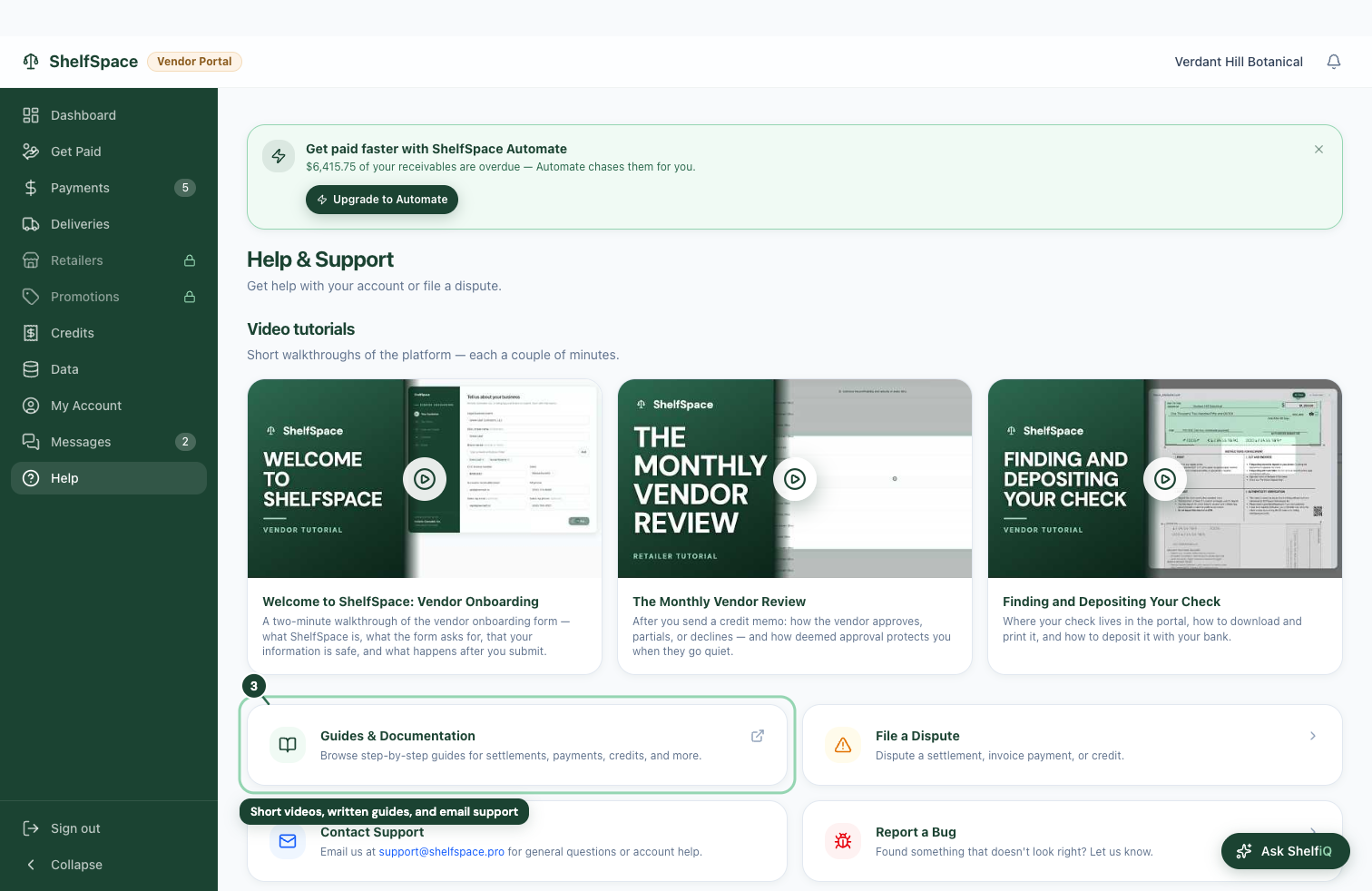
Short videos, written guides, and email support
3Short videos, written guides, and email support
Get unstuck without leaving the app. The Help page opens with short video walkthroughs and links to step-by-step written guides. If something looks wrong, email support@shelfspace.pro and a person will answer -- or file a dispute right here when a payout or credit doesn't look right. Start with the videos; most questions are a two-minute watch.

Getting Paid

This chapter is for the owner or whoever handles the money -- the account that can act. It's where you see what you're owed, deposit your checks, read exactly how each payout was figured, handle the credits your partners send you, and push back when something looks off. Everything below is one screen at a time.

See your payments and deposit your checks

One screen holds every payout and tells you -- honestly -- where the money is. A payout reaches you either as a check you download here, or as a bank transfer straight into your linked account.

4

Every payout, and what its status really means
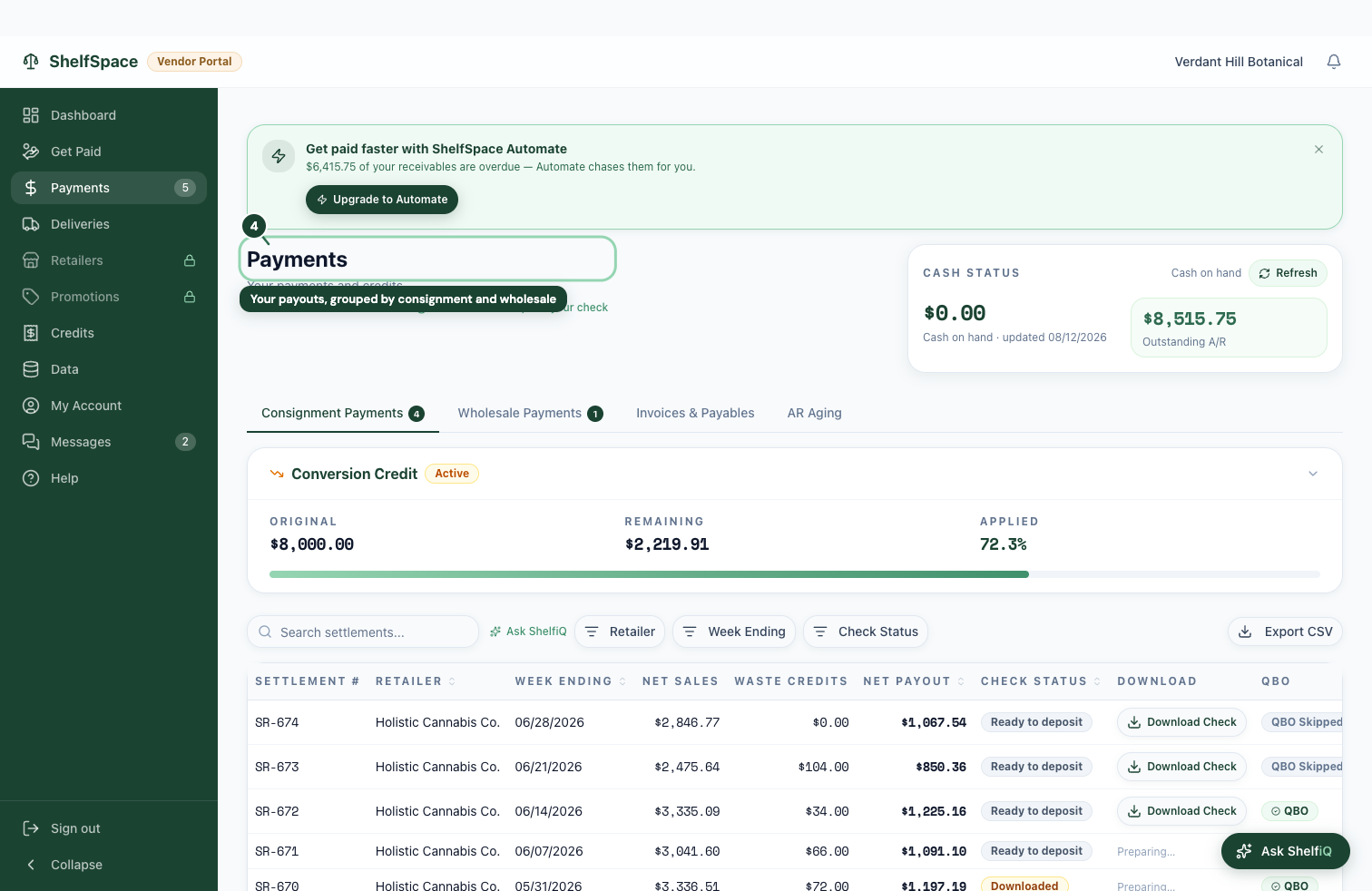
Your payouts, grouped by consignment and wholesale
4Your payouts, grouped by consignment and wholesale
This is where your money shows up. Each payout carries a status, and the status tells you the truth about where the money is: Ready to deposit means the check is cut and waiting -- go get it, download it here. Downloaded means you've pulled the check; if your retail partner's bank isn't connected to us, that's the last status you'll see, so treat it as "in your hands," not "cleared." Cleared is the only status that confirms the money actually left your partner's account -- it appears once the check is confirmed to have cleared. A check can sit Downloaded for a while before it clears, so don't read Downloaded as paid. A payout can also arrive as a bank transfer straight into your linked account, where it lands as a deposit on its own. Either way you never have to invoice for it or ask where it is -- a check waits right here for you to download and deposit, and a bank transfer arrives on its own.
5

See exactly how a payout was figured

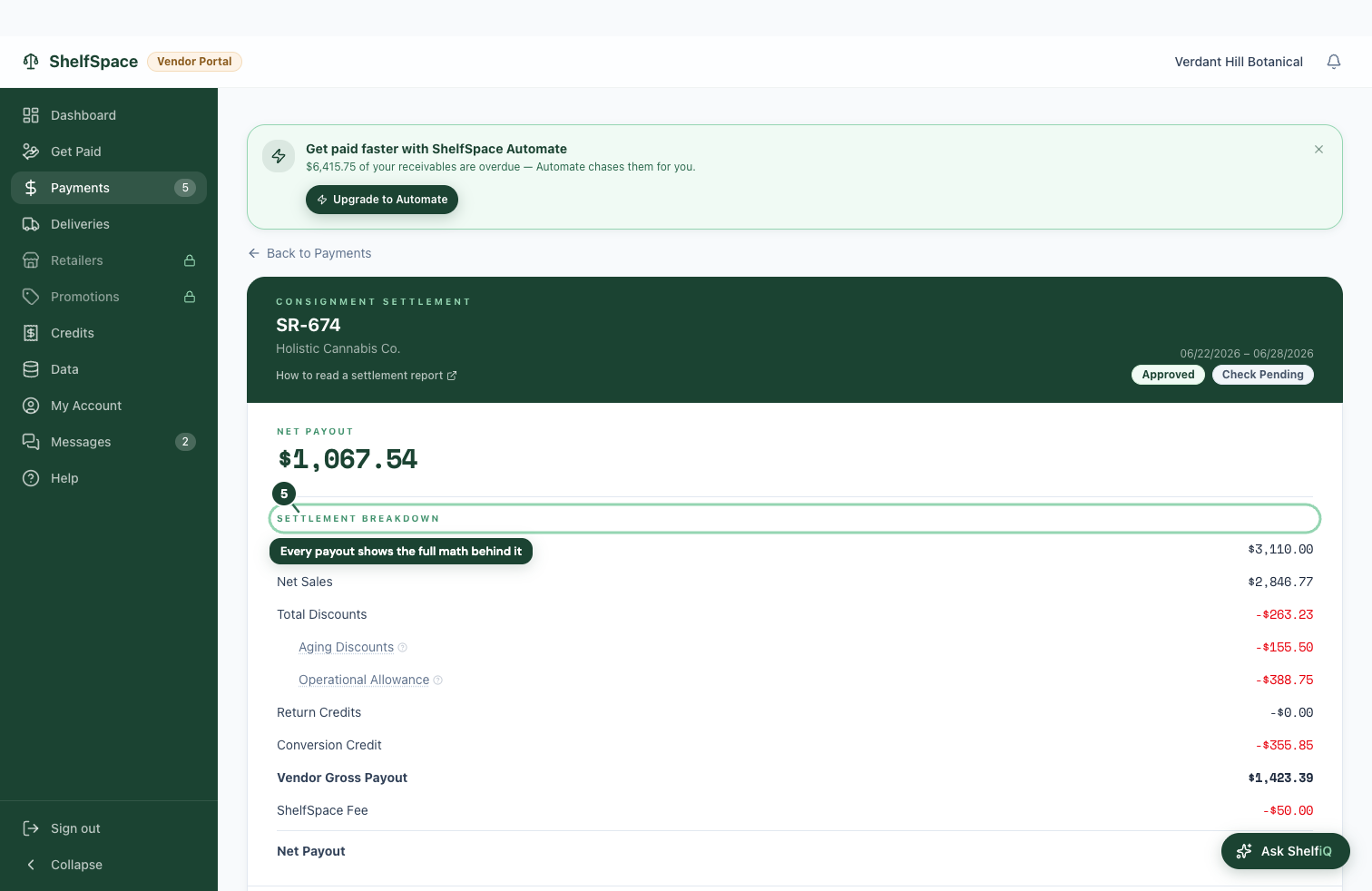
Every payout shows the full math behind it
5Every payout shows the full math behind it
Open a payout to see exactly how it was calculated. The breakdown walks you from what actually sold, to your share of each sale, to any returns and any credits netted out -- adding up to the amount you're paid. The report names the retail partner it's from, so you always know who's paying. Every line is there, so you can check the number yourself and download the full report as a PDF from this screen.

Handle credits and monthly statements

When product is returned or discounted, your partner sends you a credit -- and each month's credits arrive as one statement. You read it, and you approve it, adjust it, or push back.

6

Every credit and statement in one place
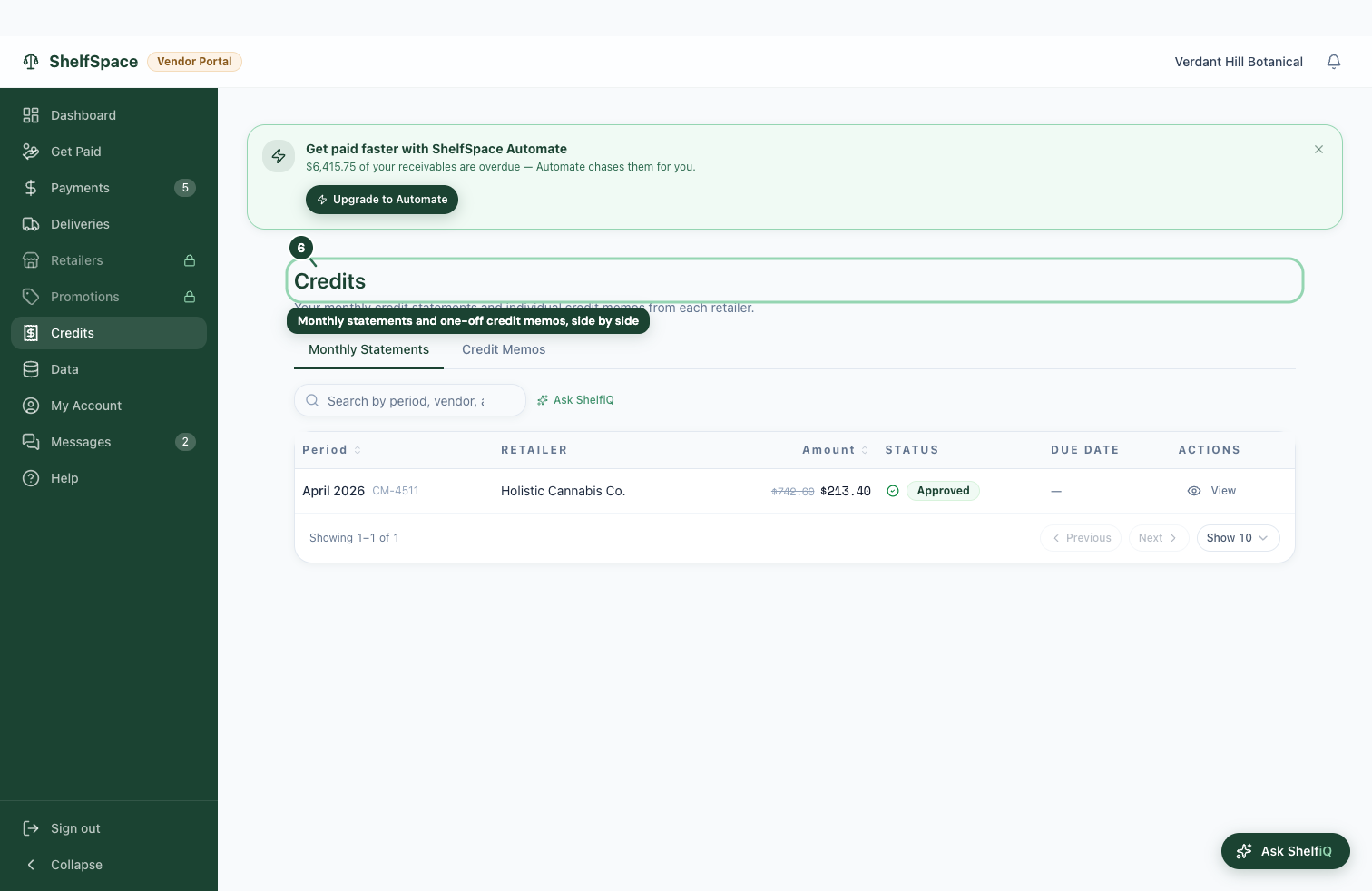
Monthly statements and one-off credit memos, side by side
6Monthly statements and one-off credit memos, side by side
This is where the credits your partners send you live. A credit covers things like customer returns and product destroyed with the state, and each month's worth arrives as a single monthly statement you review in one place. Open one to approve it, approve a different amount, or reply if something's off. Each statement gives you a window to respond -- if you don't reply by the date it shows, we treat it as accepted and it's applied to what you're paid. So open new ones promptly.
7

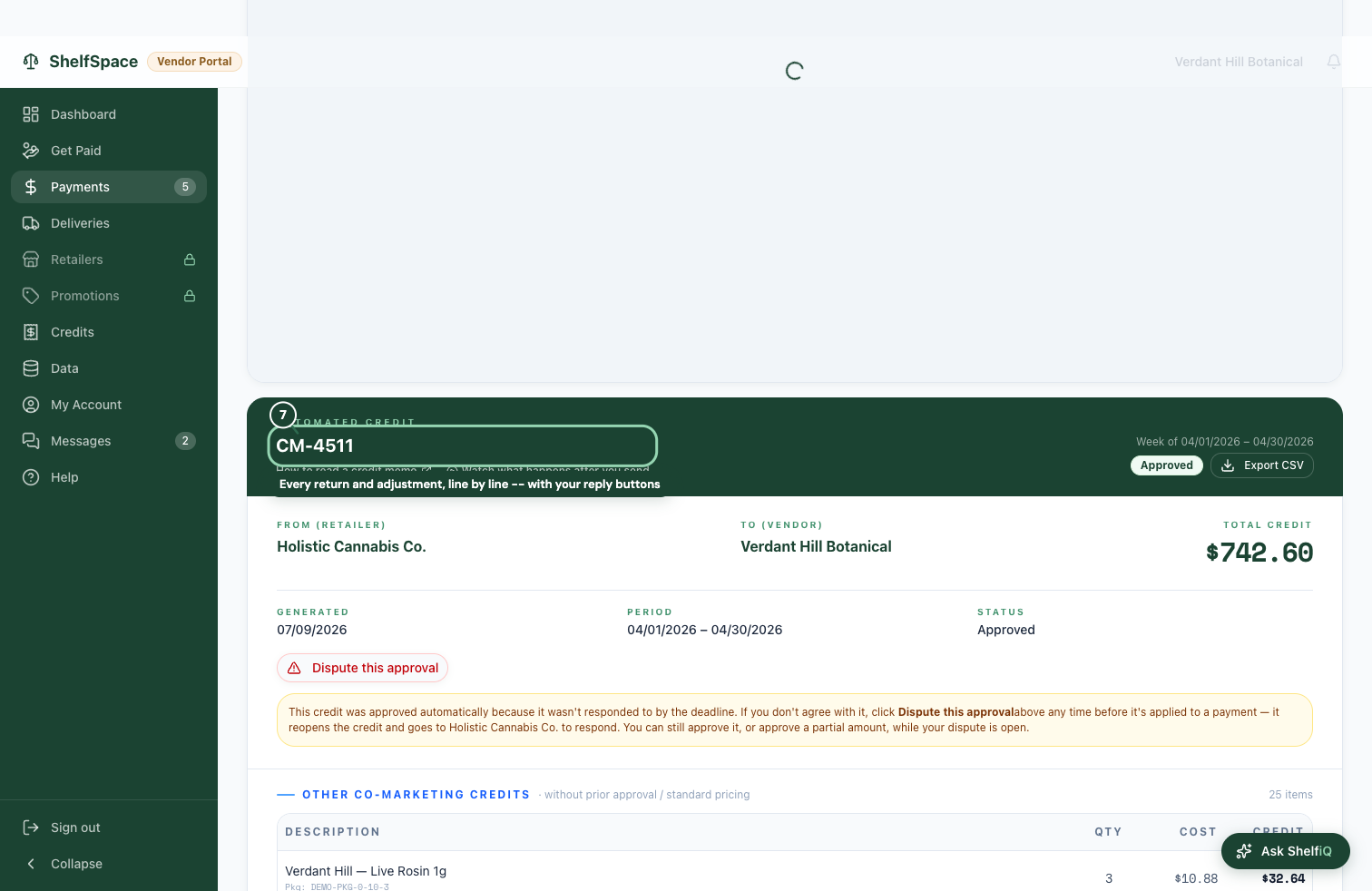
Read a statement and respond

Every return and adjustment, line by line -- with your reply buttons
7Every return and adjustment, line by line -- with your reply buttons
Open a statement to see everything it covers -- every customer return and every adjustment, line by line, with the cost behind each one. From here you choose how to respond: approve it as-is, approve a specific amount if only part looks right, or reply to work it out with your partner. Whatever you decide is applied against what you're paid, so nothing has to be settled twice.

Push back when something's off

If a payout or a credit doesn't look right, you don't have to email around for it -- you raise it here and track where it stands.

8

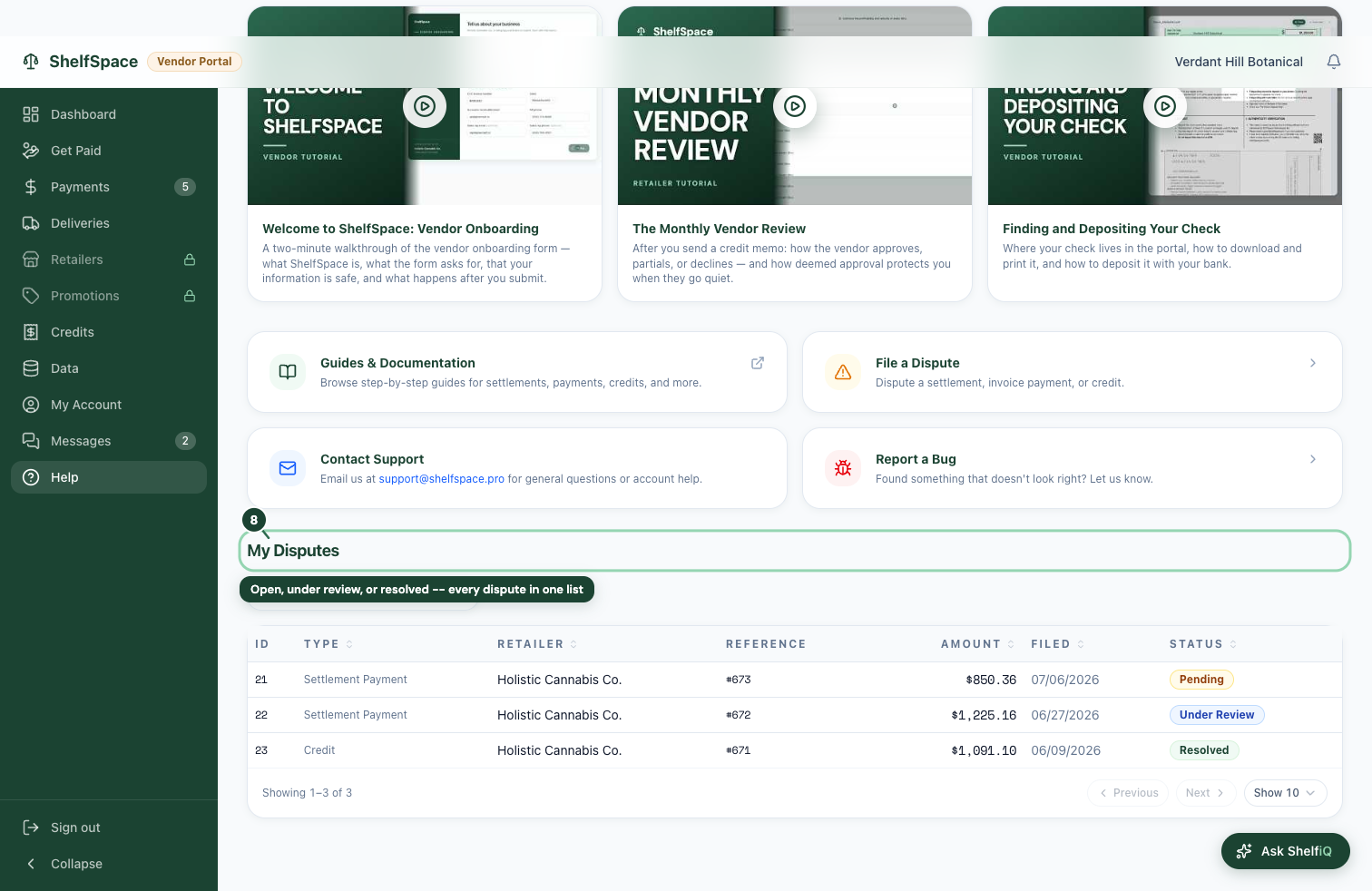
File a dispute and track it

Open, under review, or resolved -- every dispute in one list
8Open, under review, or resolved -- every dispute in one list
Raise a problem with a payout or a credit right from the Help page, and it goes straight to the retail partner it concerns. Every dispute you've filed lives in this list with where it stands -- pending, under review, or resolved -- so nothing gets lost in email. Filing a dispute on a credit that hasn't been applied to a payment yet pauses it until the two of you sort it out, so you're never rushed into accepting something that doesn't look right.

Sales & Inventory Visibility

See how your product is selling and where it lives -- your sales, the stores that carry you, what you've shipped, and the promotions and price drops in play. Viewing these screens is open to your whole team; a couple of them also let you take an action, like offering a promotion or answering a price-drop request.

Your sales and the stores that carry you

Start with what actually sold and where. One page holds your sales detail; another lists every retail partner, and you can open any one to see your terms and your shipment history with them.

9

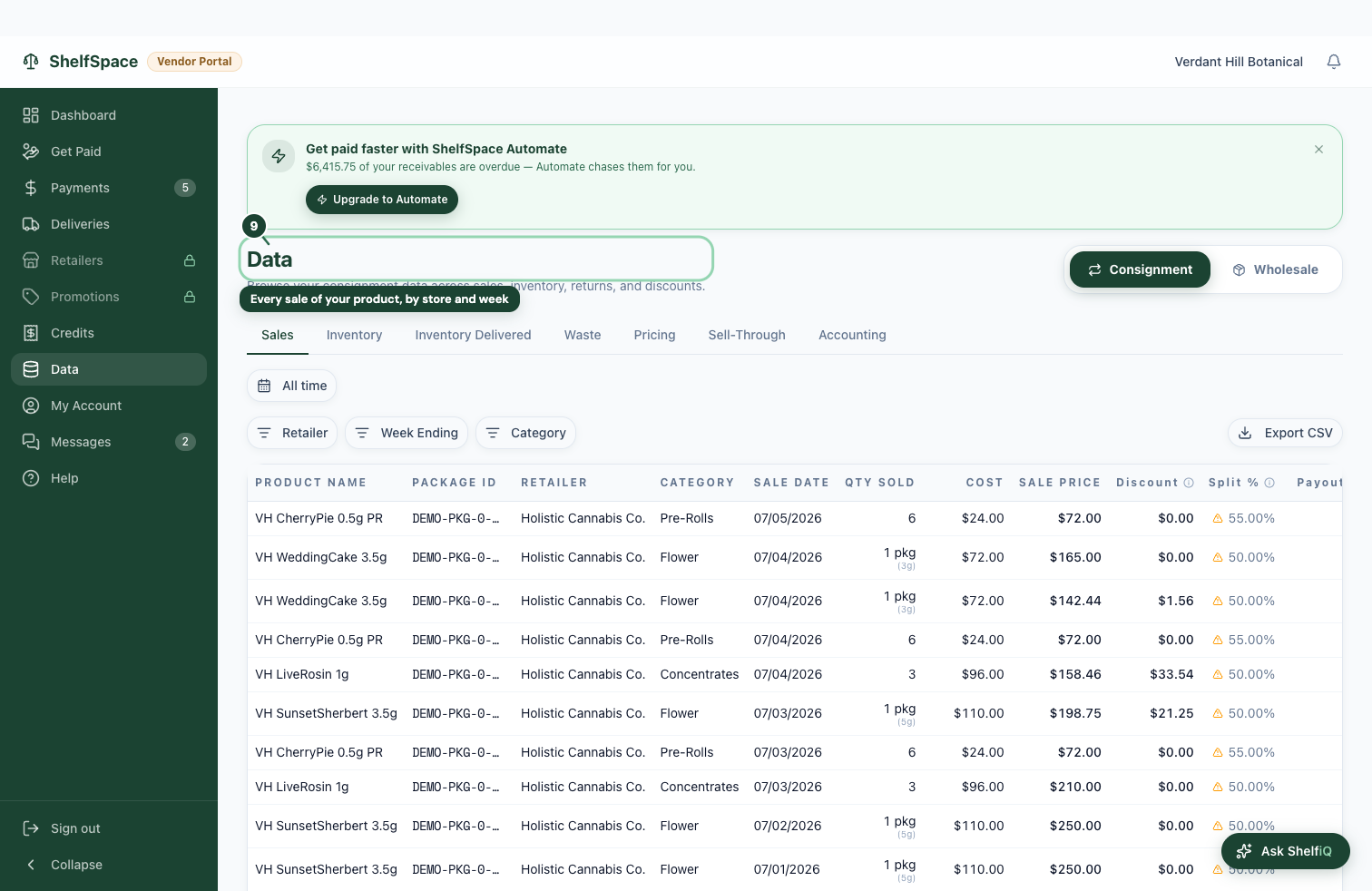
See every sale of your product

Every sale of your product, by store and week
9Every sale of your product, by store and week
This is your sell-through, straight from the register. Each row is your product moving at a retail partner -- what sold, at which store, and in which week -- so you can see what's working and what's slow without asking anyone for a report. Tabs across the top switch the view between sales, on-hand inventory, what you've delivered, waste, pricing, and sell-through, so the whole picture of your product is in one place. Sort or filter to focus on one store or one week, and use it to plan what to ship next. The numbers update on their own as your partners keep selling.
10

See how much of each invoice has sold

Each invoice you consigned, reconciled to the unit
10Each invoice you consigned, reconciled to the unit
The Invoice Payoff tab, under the Consignment view, shows exactly how much of every invoice you consigned has sold -- and how much is still on your retail partner's shelf. For each invoice you'll see units received, sold, returned, destroyed, and remaining, across every partner that carries you, so you never have to email anyone to find out where your product stands. Watch an invoice move toward Closed and you know a store is selling through and it's time to send more; see units parked in Remaining for weeks and you know to ask about placement before you ship again. It's the same numbers your partner sees -- which is what keeps a consignment relationship from breaking down over a spreadsheet mismatch.
11

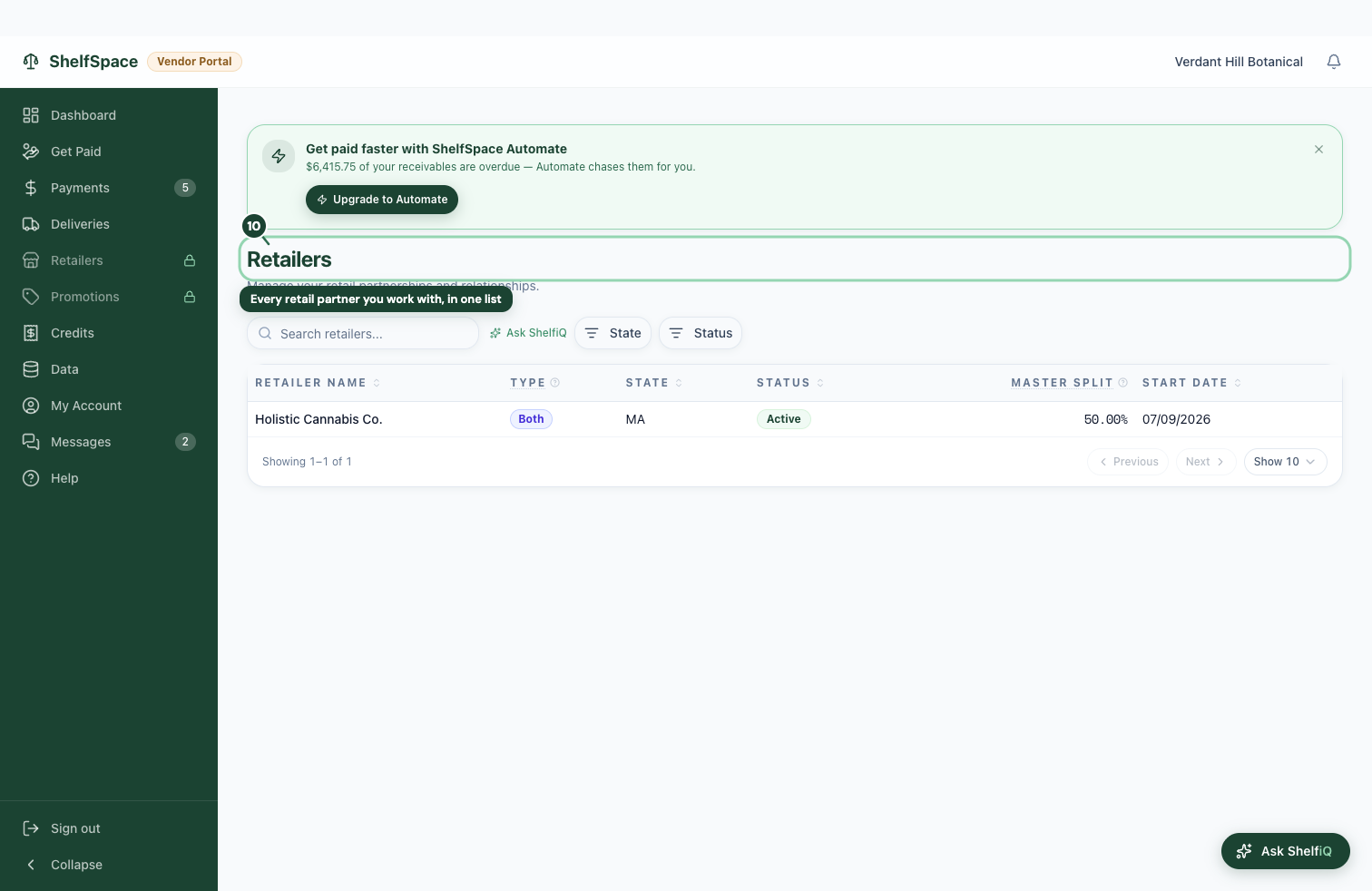
See every store that carries you

Every retail partner you work with, in one list
11Every retail partner you work with, in one list
Every retail partner that carries your product is here in one list. Each one shows who they are and the shape of your relationship at a glance, so you always know where your product lives. Open any partner to see the details -- your terms with them, who to contact, and every shipment you've sent -- on the next screen.
12

Open one partner to see terms and manifests
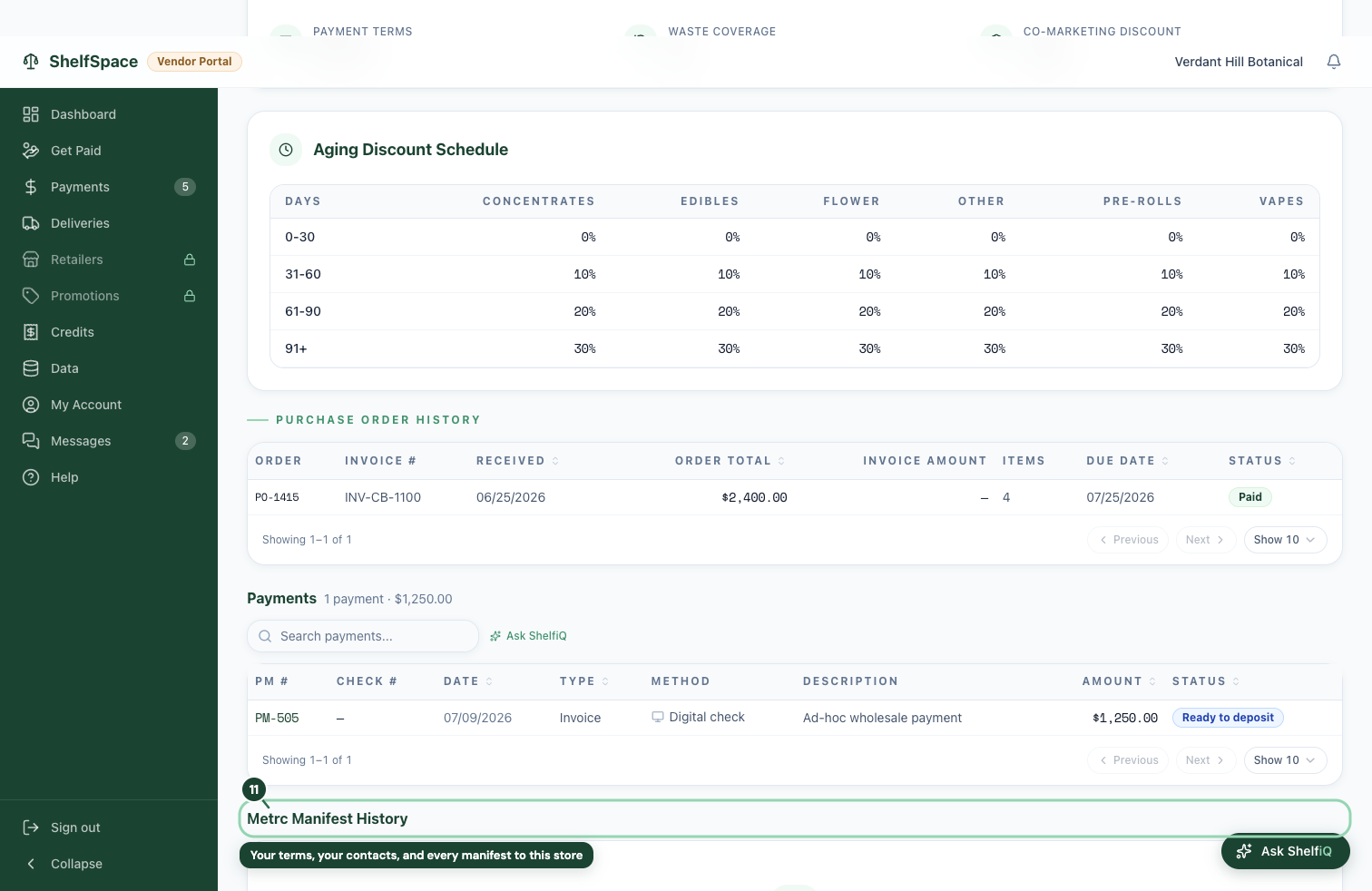
Your terms, your contacts, and every manifest to this store
12Your terms, your contacts, and every manifest to this store
One partner's full picture lives here. The top of the page shows the terms you're working under -- your split, your payment terms, and how product is returned -- alongside the people to contact at that store. Scroll down and you'll find the manifest history: every state-tracked transfer you've sent this partner, so what you shipped and what the store received always line up. It's the single place to confirm a delivery landed the way it should.

Shipments, promotions, and price drops

The rest of your visibility: what you've shipped and where each shipment stands, plus the promotions and aged-inventory price drops your partners are running on your product.

13

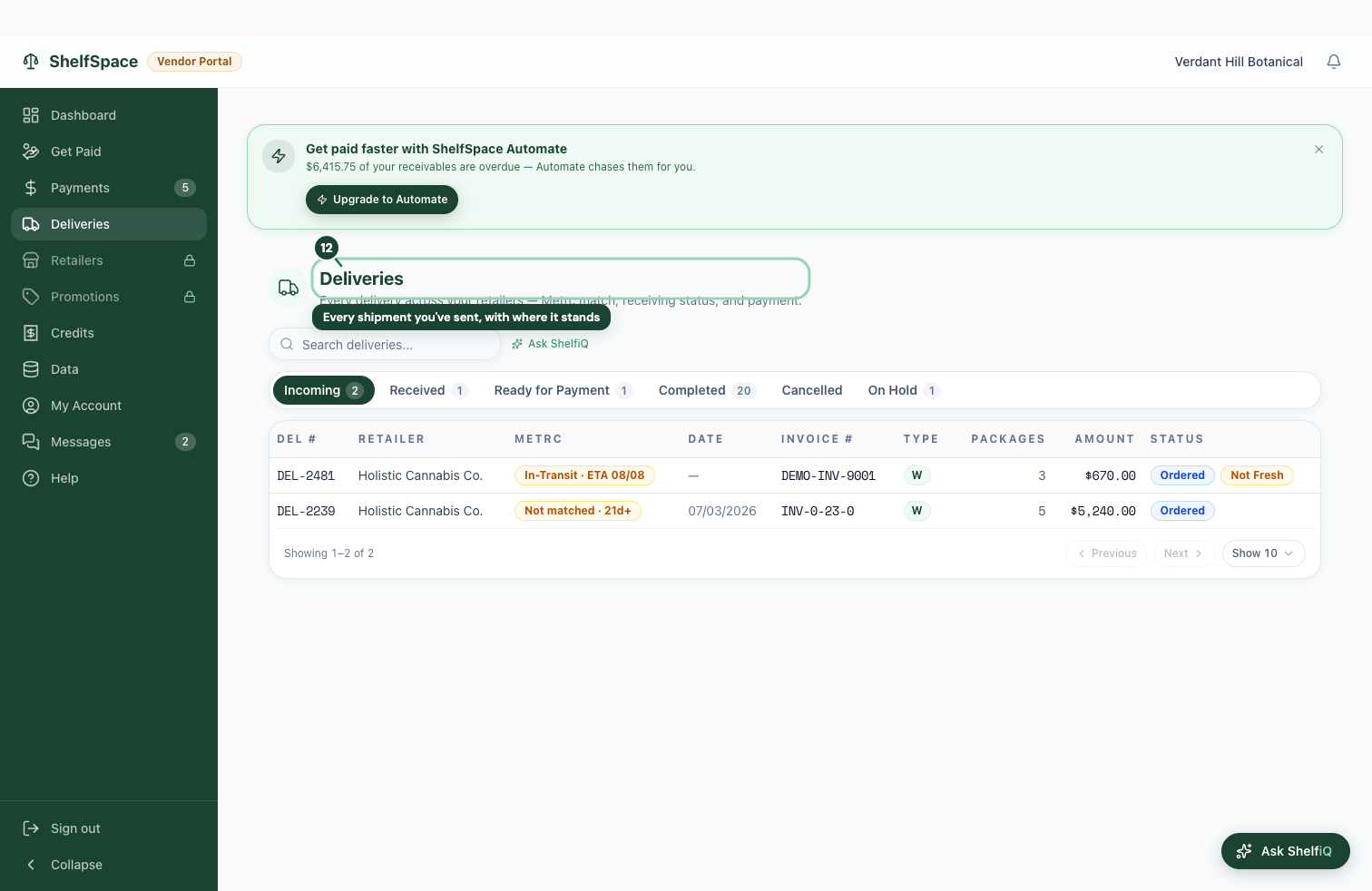
Track what you've shipped

Every shipment you've sent, with where it stands
13Every shipment you've sent, with where it stands
Every shipment you've sent a partner is here, with its status. You can see what's on the way, what's been received, and what's been paid -- so a delivery never disappears into a black box between leaving your dock and showing up on a payout. Open a row for the line-by-line detail. This is a view: the retail partner is the one who receives and verifies each delivery on their end.
14

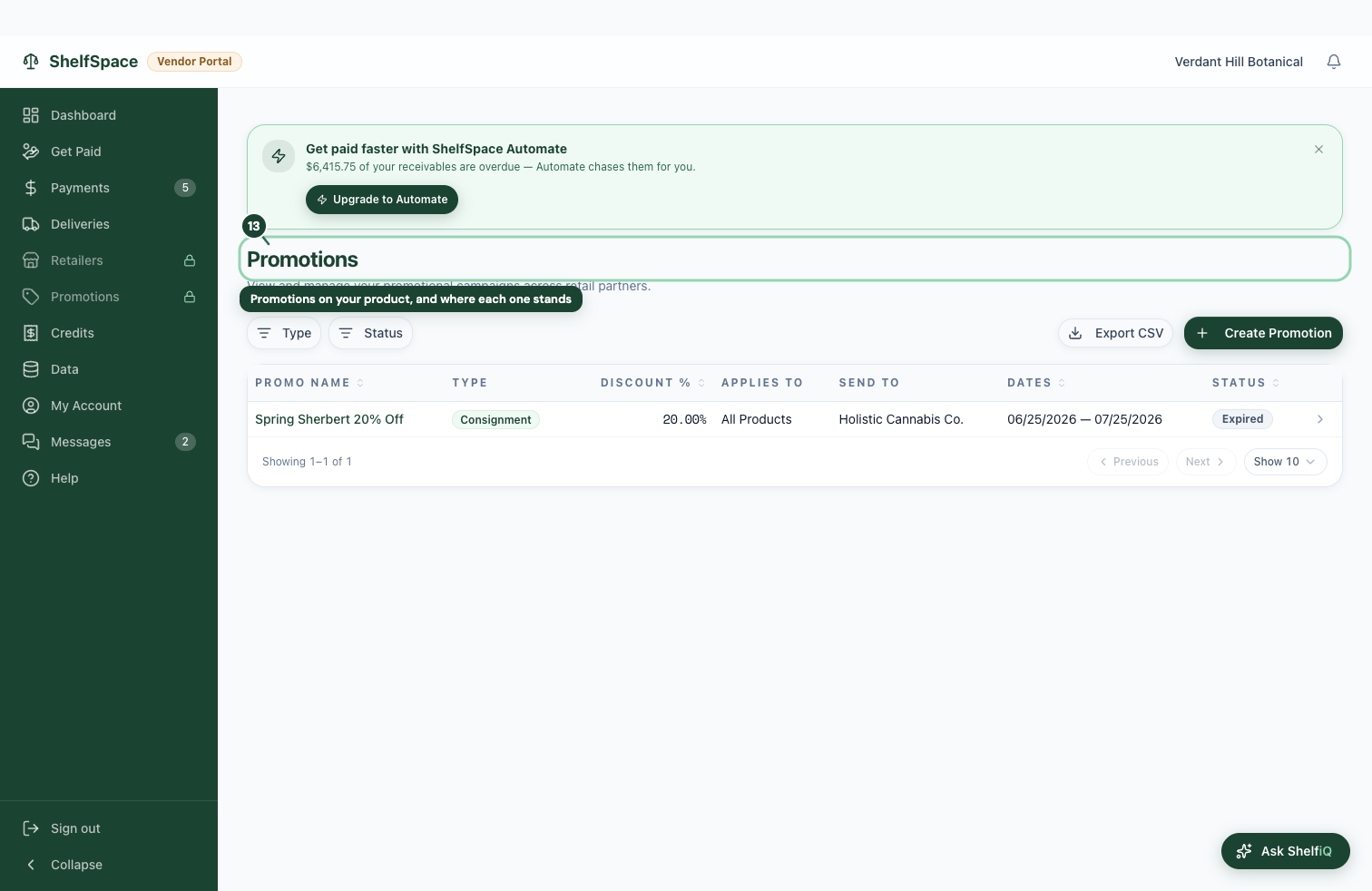
See the promotions on your product

Promotions on your product, and where each one stands
14Promotions on your product, and where each one stands
Promotions on your product live here. You can offer a retail partner a temporary discount straight from this page with Create Promotion, and it tracks every one you've run -- what's discounted, which partner it went to, the dates, and whether it's live or expired. Open a row to see how one is doing. If nothing is running, the list stays empty until you or a partner sets one up.
15

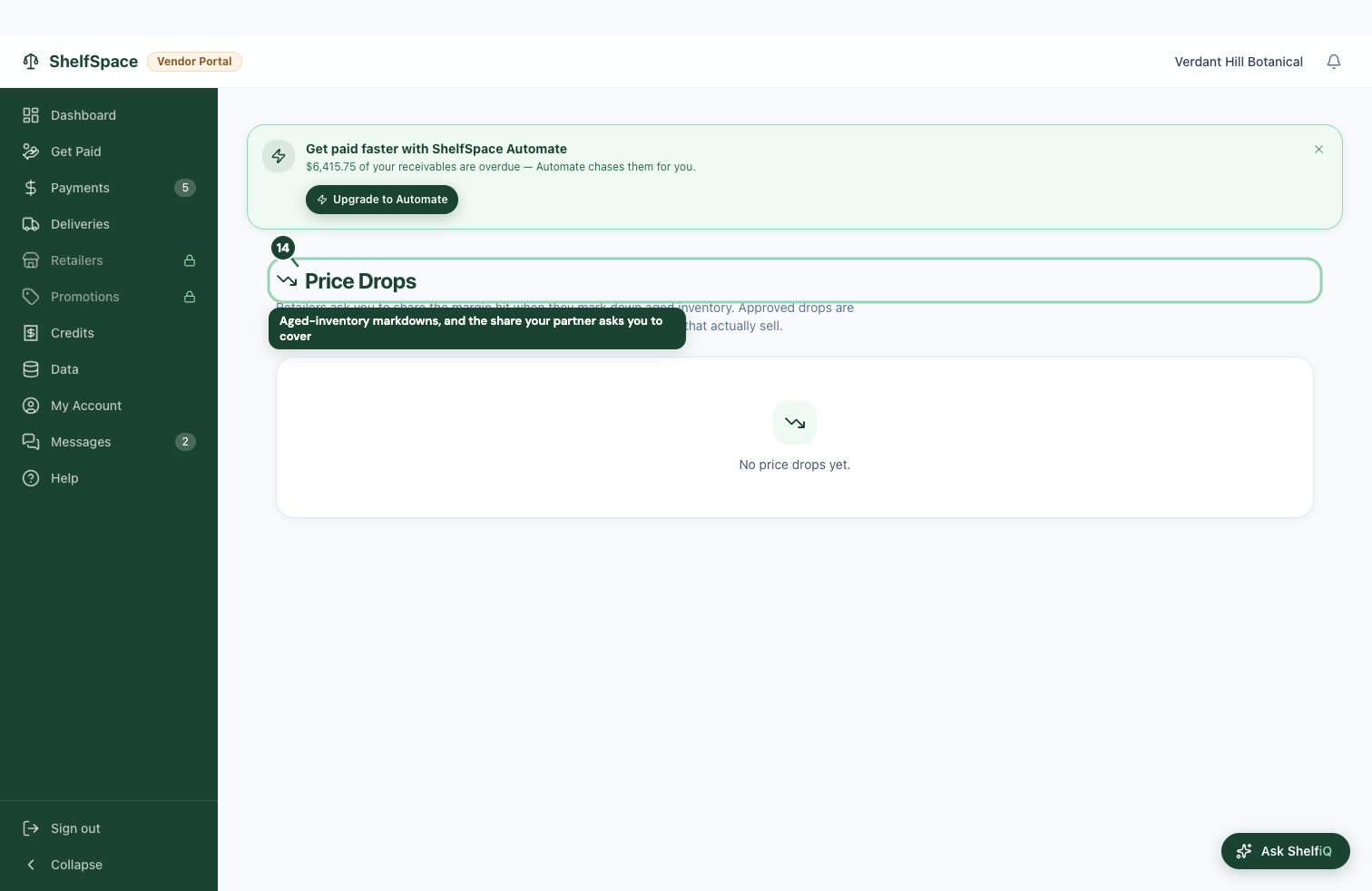
See price drops on your aged product

Aged-inventory markdowns, and the share your partner asks you to cover
15Aged-inventory markdowns, and the share your partner asks you to cover
When a partner marks down aged product and asks you to share the hit, the request lands here. Each one shows the product, the markdown, and the share they're asking you to cover -- and you only pay your share on units that actually sell. If a request needs an answer, it waits here for you. If none is open right now, the list stays empty until a partner sends one.

Read-Only Access

Some people on your team should mostly watch, not change things. That's the view-only seat -- the most limited login. It reads every screen in this guide -- payouts, credits, sales, deliveries -- and the only thing it can act on is a promotion a retail partner proposes. Give it to anyone who needs to keep an eye on the account without touching the money or the settings.

What the view-only seat can and can't do

Here's the honest line between the seats, so you hand out the right one.

16

The same screens, without the action buttons
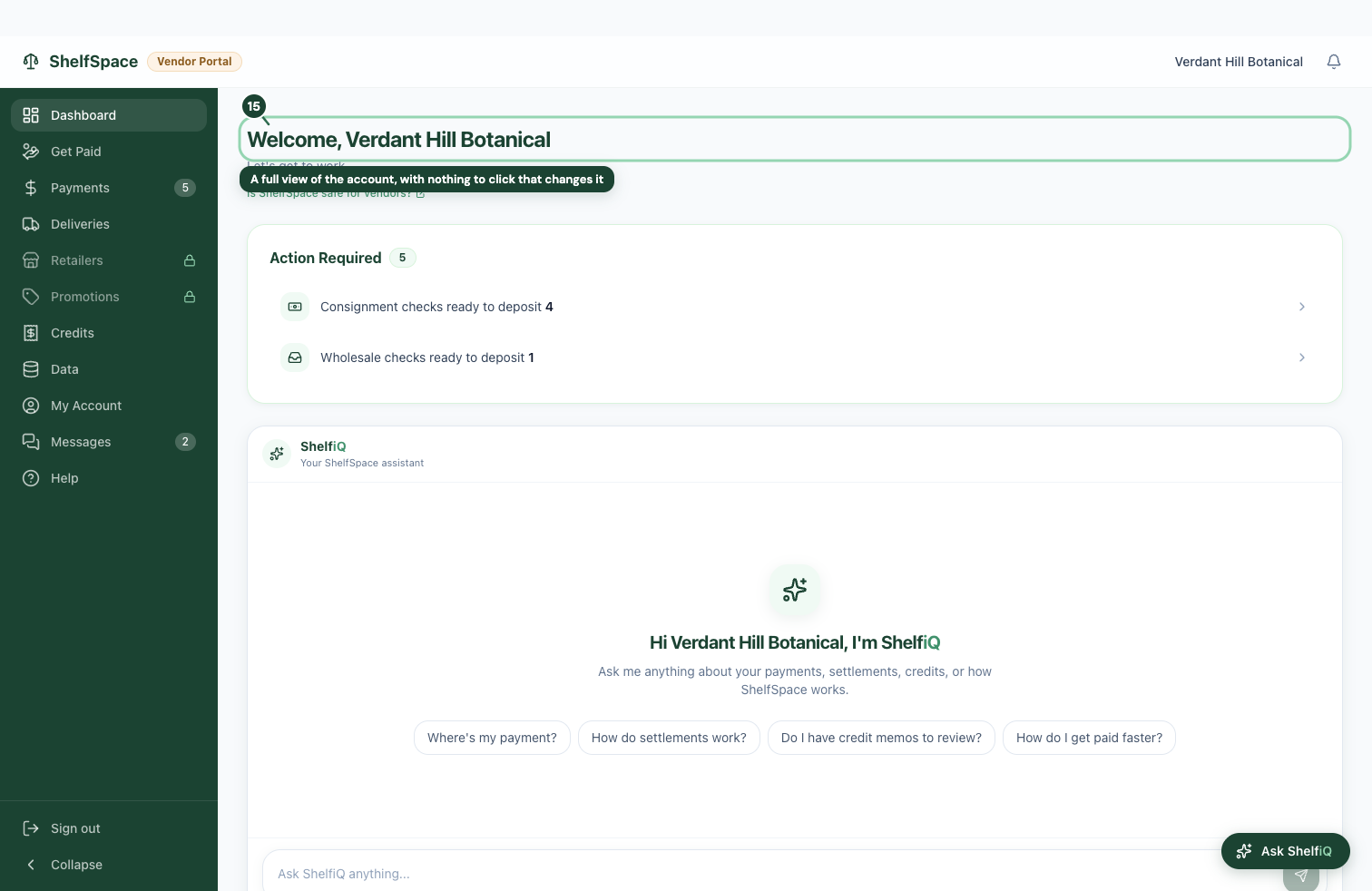
A full view of the account, with nothing to click that changes it
16A full view of the account, with nothing to click that changes it
This is the dashboard as a view-only teammate sees it -- the same home screen, the same numbers, read-only almost everywhere. This seat can open and read everything: payouts and their status, credits and monthly statements, your sales and deliveries. The one action it can take is answering a promotion a retail partner proposes -- approve or decline. Everything else that moves money or changes settings is off-limits: it can't approve or reply to a credit, file a dispute, answer a price-drop request, change your bank or payout details, connect QuickBooks, or add and remove users. Those belong to the owner, general manager, or accounts-receivable seat. There's also a middle Sales & Ops seat: it can do everything the view-only seat can, plus answer price-drop requests, while still not holding the bank account or the account settings. Pick view-only for a silent partner or an outside bookkeeper who should mostly watch; pick Sales & Ops for a rep who works the accounts day to day.

Full Feature Reference

The rest of the portal, screen by screen -- the tools you'll reach for less often, but should know are here. Bill your own buyers, open a single shipment or promotion in full, manage your account and your team, and keep your books in sync. Everything below is what the owner or accounts-receivable seat can see and do.

Bill your own buyers and collect

Separate from the payouts your ShelfSpace partners send you, this is your own billing desk -- for invoicing the shops you sell to directly and chasing what they owe.

17

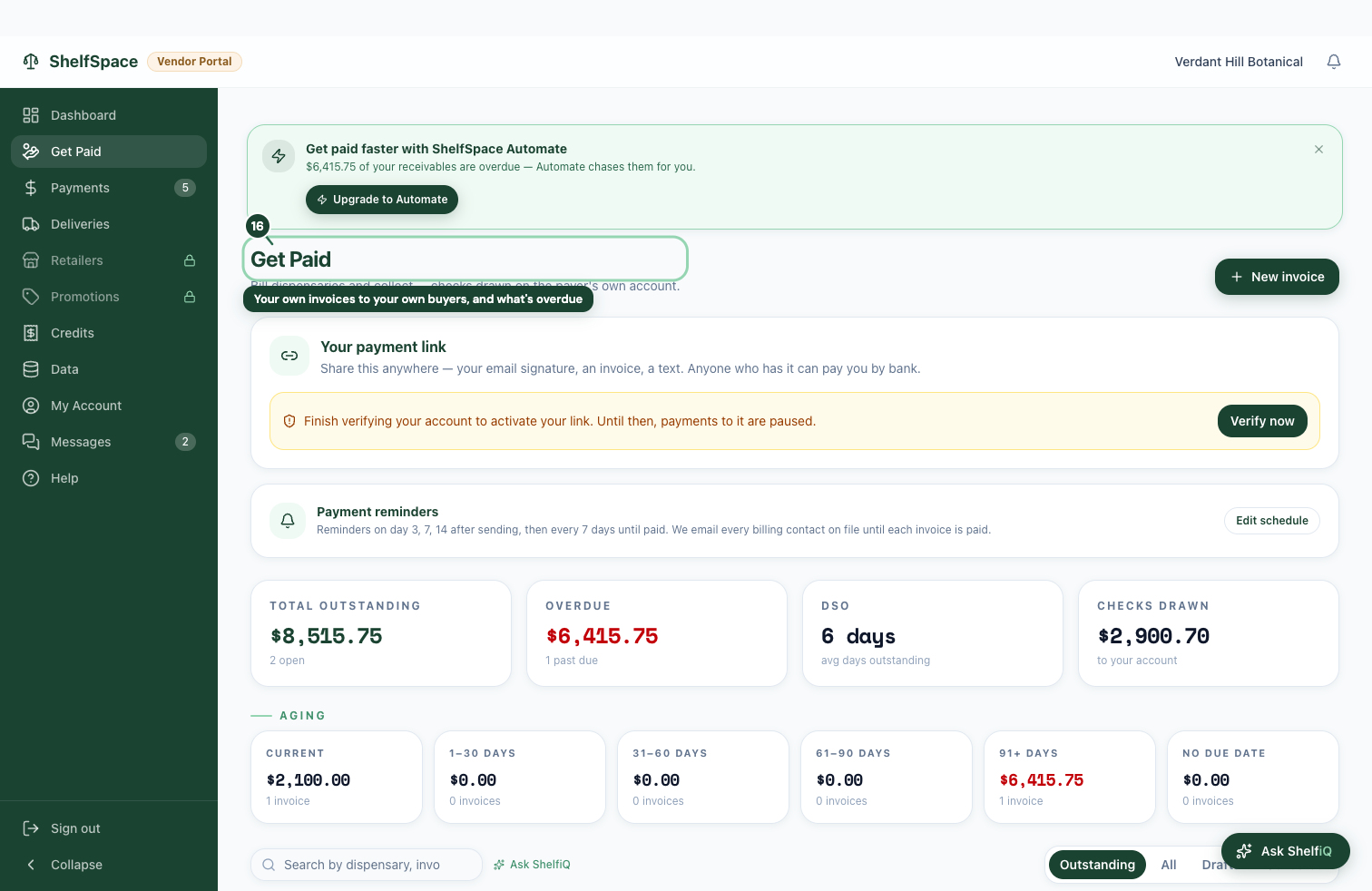
Invoice your buyers and follow up

Your own invoices to your own buyers, and what's overdue
17Your own invoices to your own buyers, and what's overdue
Get Paid is your billing desk for the shops you sell to directly -- separate from the payouts your ShelfSpace retail partners already send you. Create an invoice for a buyer, and the screen tracks what's outstanding, what's coming due, and what's overdue, so you can send a reminder before an account slips. When a buyer pays by check, the check is drawn on their own account and lands with you -- you're never waiting on us to move it. Use this when you invoice buyers outside your ShelfSpace settlements and want one place to see who still owes you.

Open one order, bill, or promotion in full

Every list drills into a detail page. Here are the three you'll open most: a single shipment, the bill behind a wholesale order, and one promotion end to end.

18

Open a shipment for the full detail

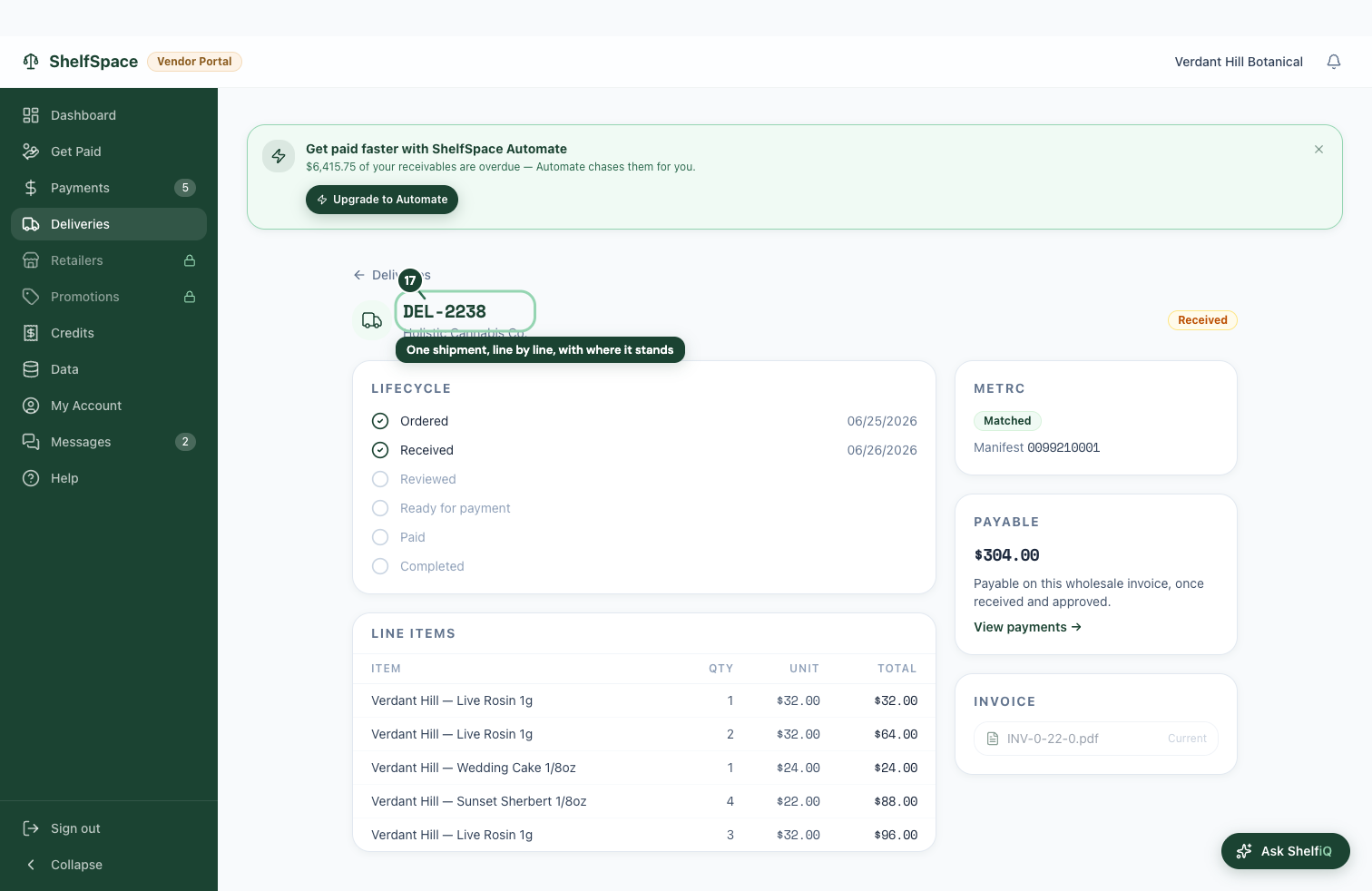
One shipment, line by line, with where it stands
18One shipment, line by line, with where it stands
Open any shipment from your Deliveries list to see it in full. The header carries its status and its state-tracked transfer number; below it a timeline follows the shipment from ordered to received to paid, every line you sent is laid out -- product, quantity, and cost -- and a match indicator confirms the state-tracked transfer lines up. It's the single place to follow one delivery from your dock to the payout it feeds. Your partner is the one who receives and verifies it on their end; this is your matching view of the same shipment.
19

See the bill behind a wholesale order
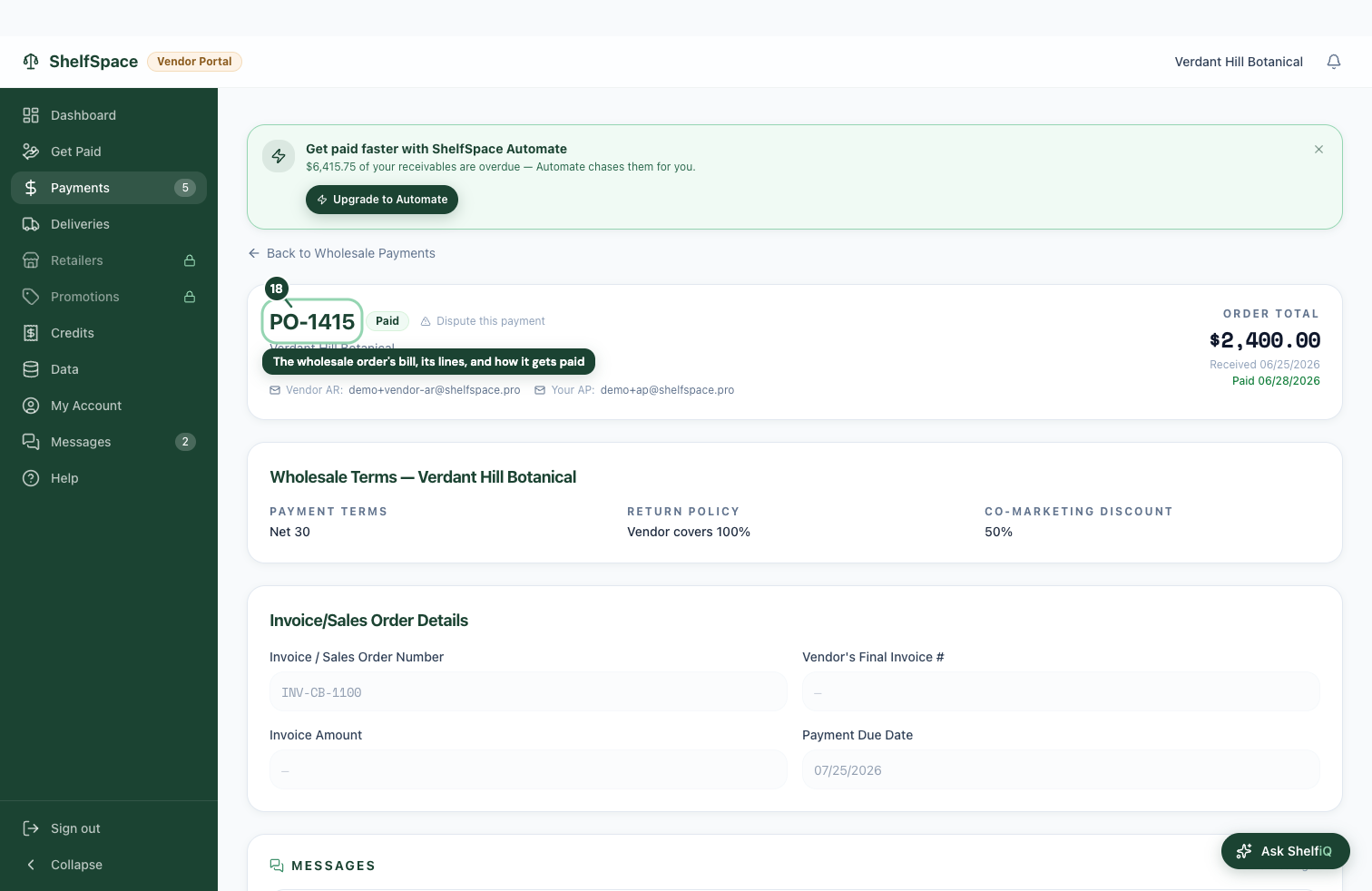
The wholesale order's bill, its lines, and how it gets paid
19The wholesale order's bill, its lines, and how it gets paid
When a retail partner buys your product outright rather than on consignment, that order becomes a bill -- and this is where you read it. It shows every line and charge, the invoice it matches, and the payment status, so what you shipped and what you're paid always line up. Open it from a payout row to check the math on one wholesale order before it's paid.
20

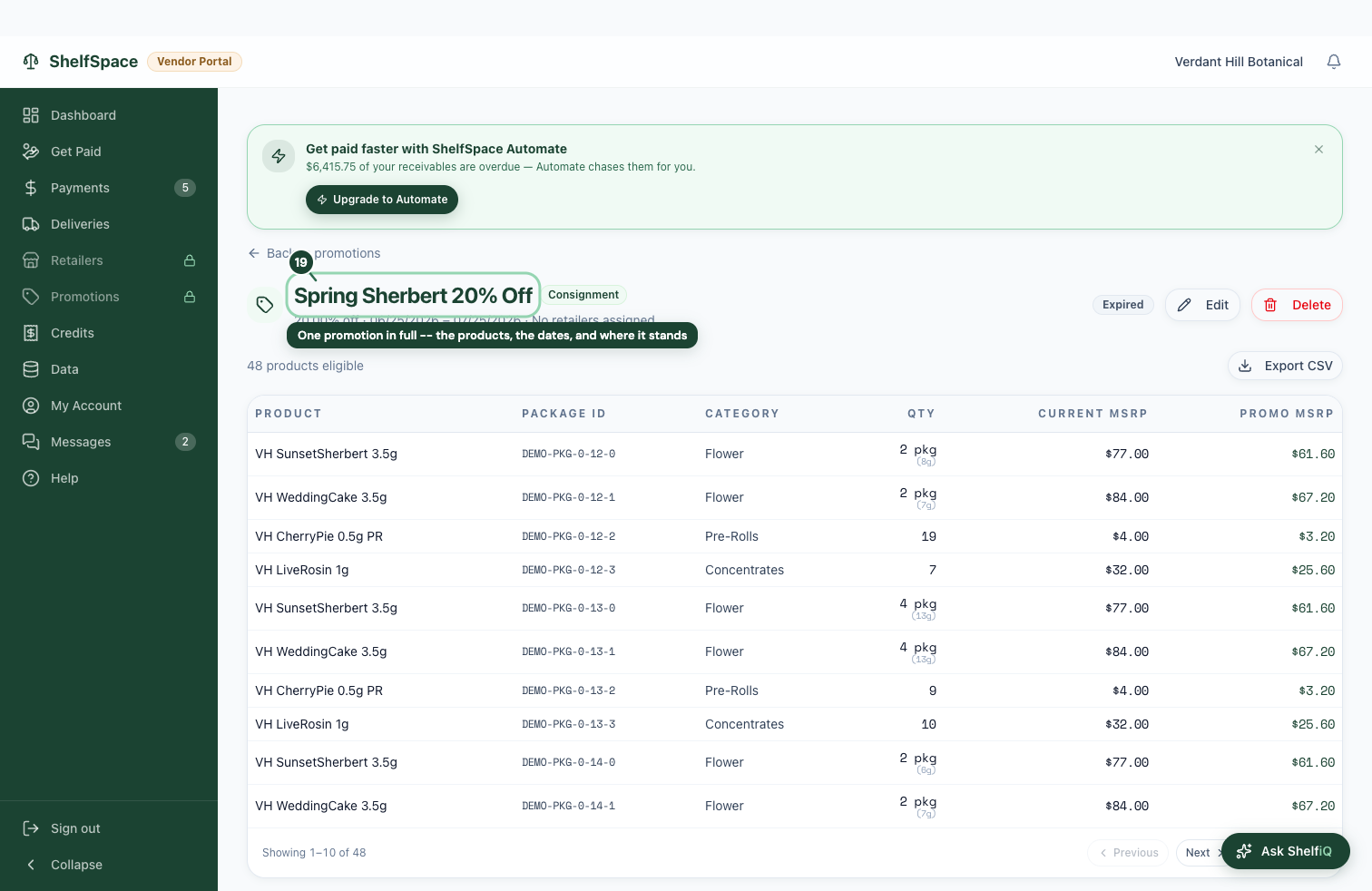
Open one promotion end to end

One promotion in full -- the products, the dates, and where it stands
20One promotion in full -- the products, the dates, and where it stands
Open any promotion to see the whole thing: which of your products it covers, the discount and the dates, and its status from proposed to running to finished. If a retail partner proposed it to you, this is where you approve or decline it and where a message thread keeps the back-and-forth in one place. If you started it, it's where you watch how it's doing. Everything about a single promotion lives on this one page.

Your account, team, plan, and messages

The settings side of the portal: your business profile and bank details, who on your team can log in, turning on paid features, and the conversations you're having with your partners.

21

Your business profile and bank details
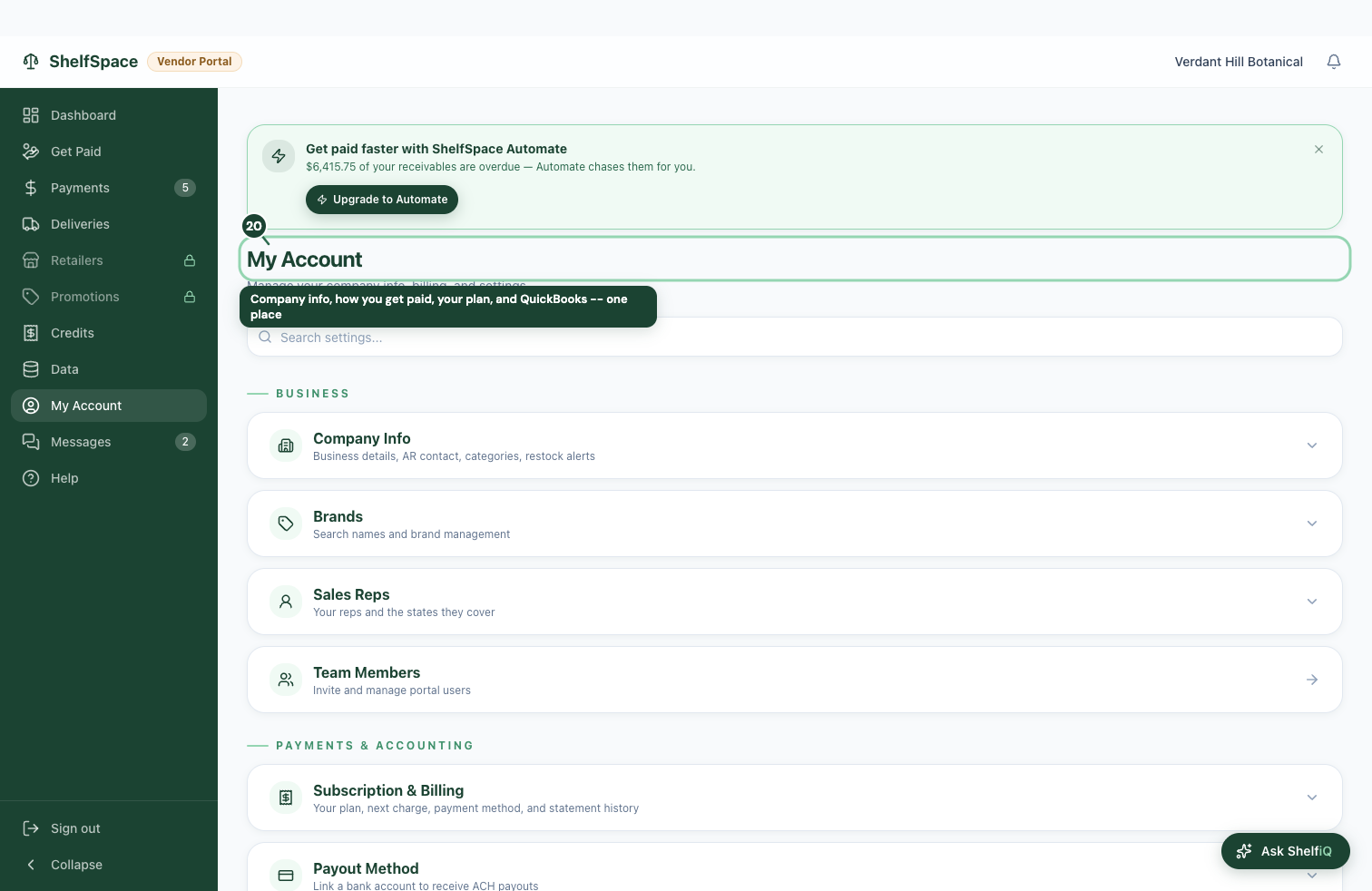
Company info, how you get paid, your plan, and QuickBooks -- one place
21Company info, how you get paid, your plan, and QuickBooks -- one place
My Account is everything about your business in one place. Update your company details and license, choose how you get paid -- a check you download, or a bank transfer straight to your linked account -- review your plan and billing history, and manage security. It's also where you connect QuickBooks and set your brands. Only the owner, general manager, or accounts-receivable seat can change your banking and account settings; everyone else sees them read-only.
22

Add teammates and set what they can do
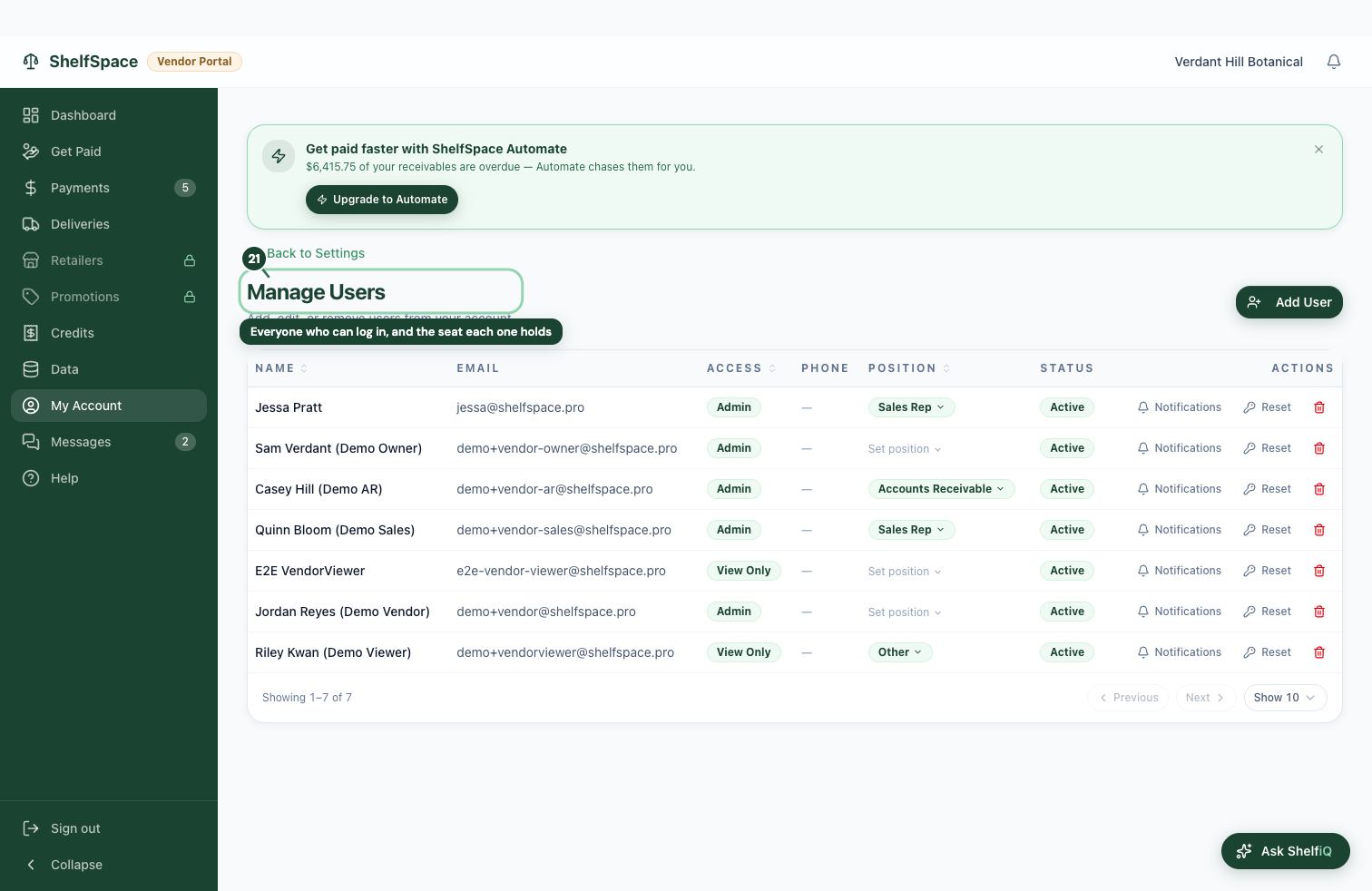
Everyone who can log in, and the seat each one holds
22Everyone who can log in, and the seat each one holds
Add the people on your team who need their own login, and give each the right seat: the owner, general manager, or accounts-receivable seat can do everything, a middle Sales & Ops seat can also answer price-drop requests, and a view-only seat reads without changing anything. You invite someone by email and they set their own password -- you never share a login. Come back here to change a seat or remove access when someone leaves.
23

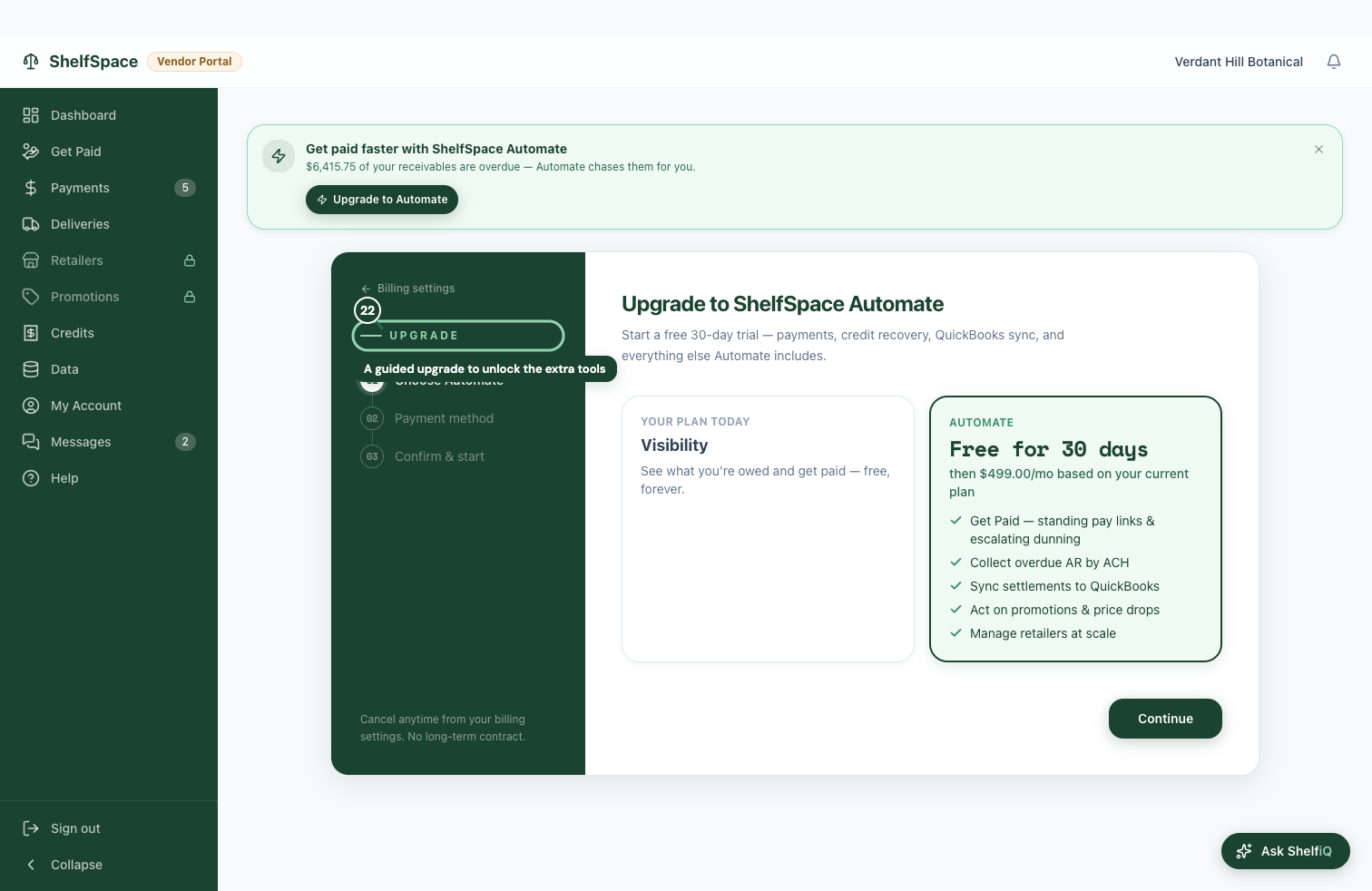
Turn on the paid features

A guided upgrade to unlock the extra tools
23A guided upgrade to unlock the extra tools
Most of what you need is free. When you want the extra tools -- the deeper visibility and automation some seats are locked out of on the free plan -- this guided flow walks you through turning them on, a step at a time. You'll land here from any upgrade prompt in the app. Nothing changes until you finish the flow and confirm.
24

Every conversation, grouped by partner
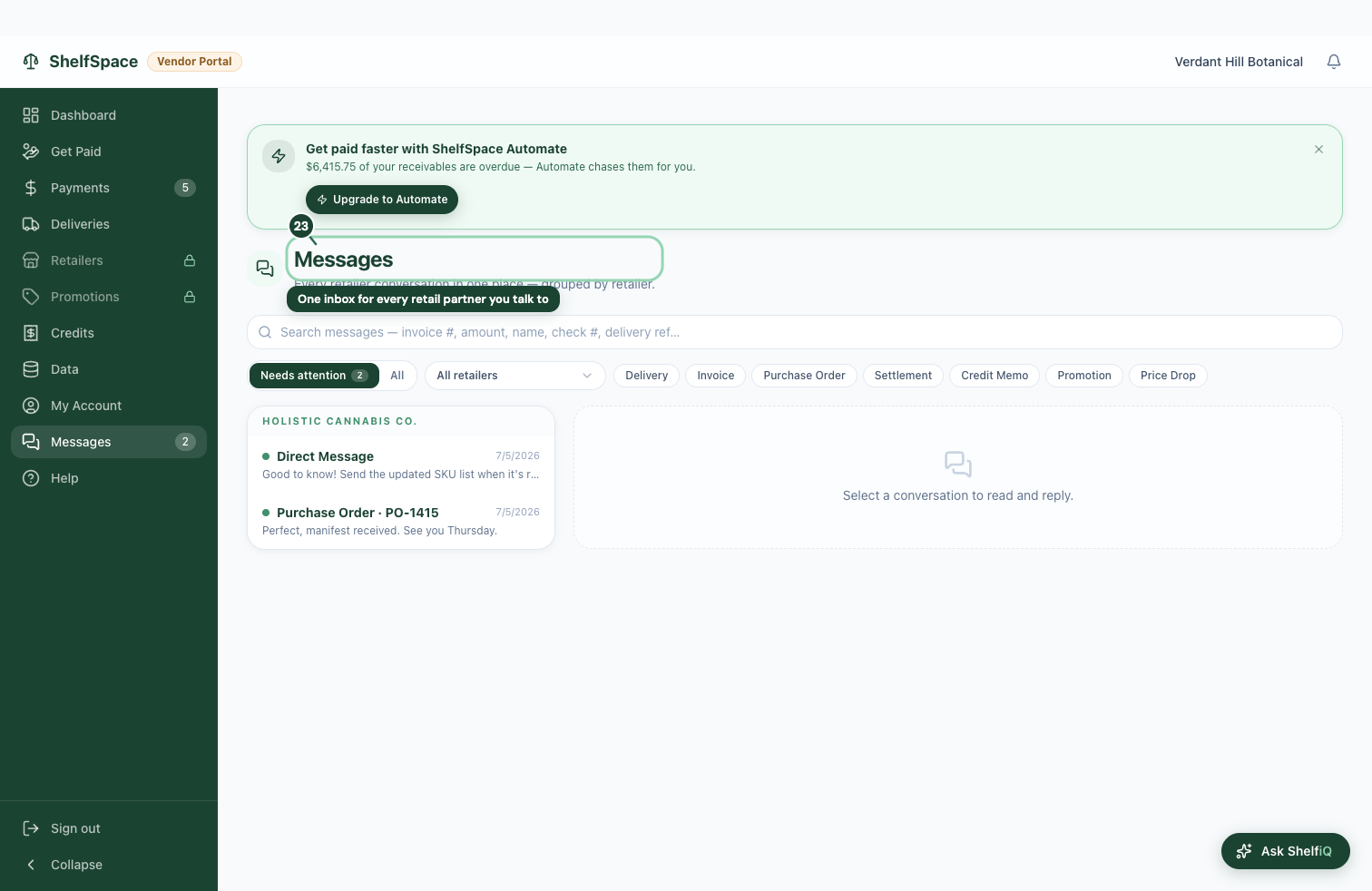
One inbox for every retail partner you talk to
24One inbox for every retail partner you talk to
Messages gathers every conversation with your retail partners into one inbox, grouped by partner, so a question about a payout or a credit doesn't get lost in your email. Open a partner to see the whole thread and reply right here. It's the same conversation your partner sees on their side, so nothing falls through the cracks between the two of you.

Keep QuickBooks in sync

If you keep your books in QuickBooks, ShelfSpace can post your settlements straight into it. Once you've connected QuickBooks in My Account, these screens control the details -- which of your books each store and product maps to, and pulling in invoices you billed outside ShelfSpace.

25

Pull in invoices you billed outside ShelfSpace
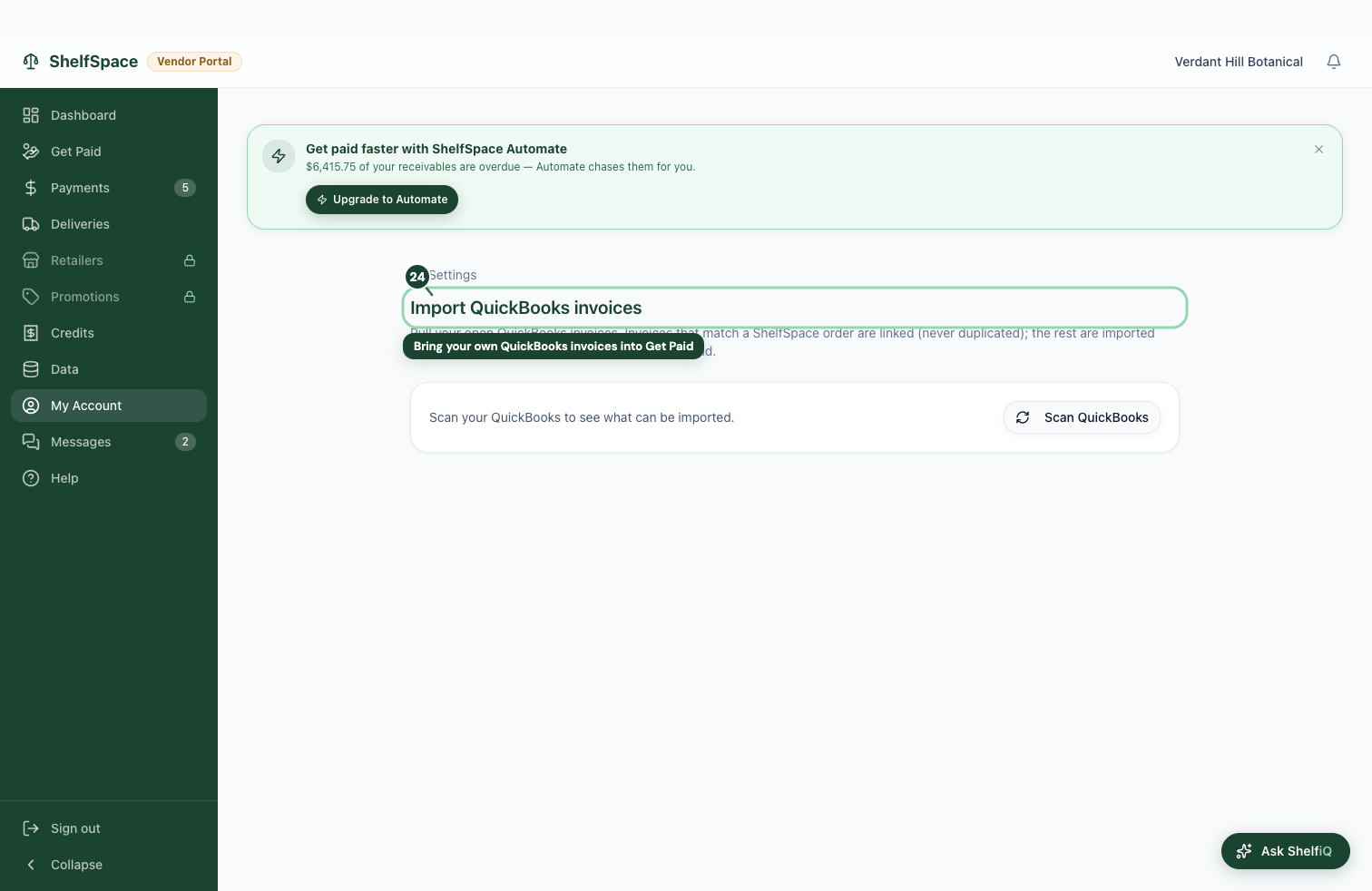
Bring your own QuickBooks invoices into Get Paid
25Bring your own QuickBooks invoices into Get Paid
If you invoice some buyers straight out of QuickBooks, this queue pulls those open invoices in so your whole accounts-receivable picture -- what everyone owes you -- lives in Get Paid too. An invoice that already matches a ShelfSpace order links up instead of doubling, so nothing is counted twice. Pick the ones to bring over and import them. This appears once you've connected QuickBooks.
26

Match each store to a QuickBooks customer
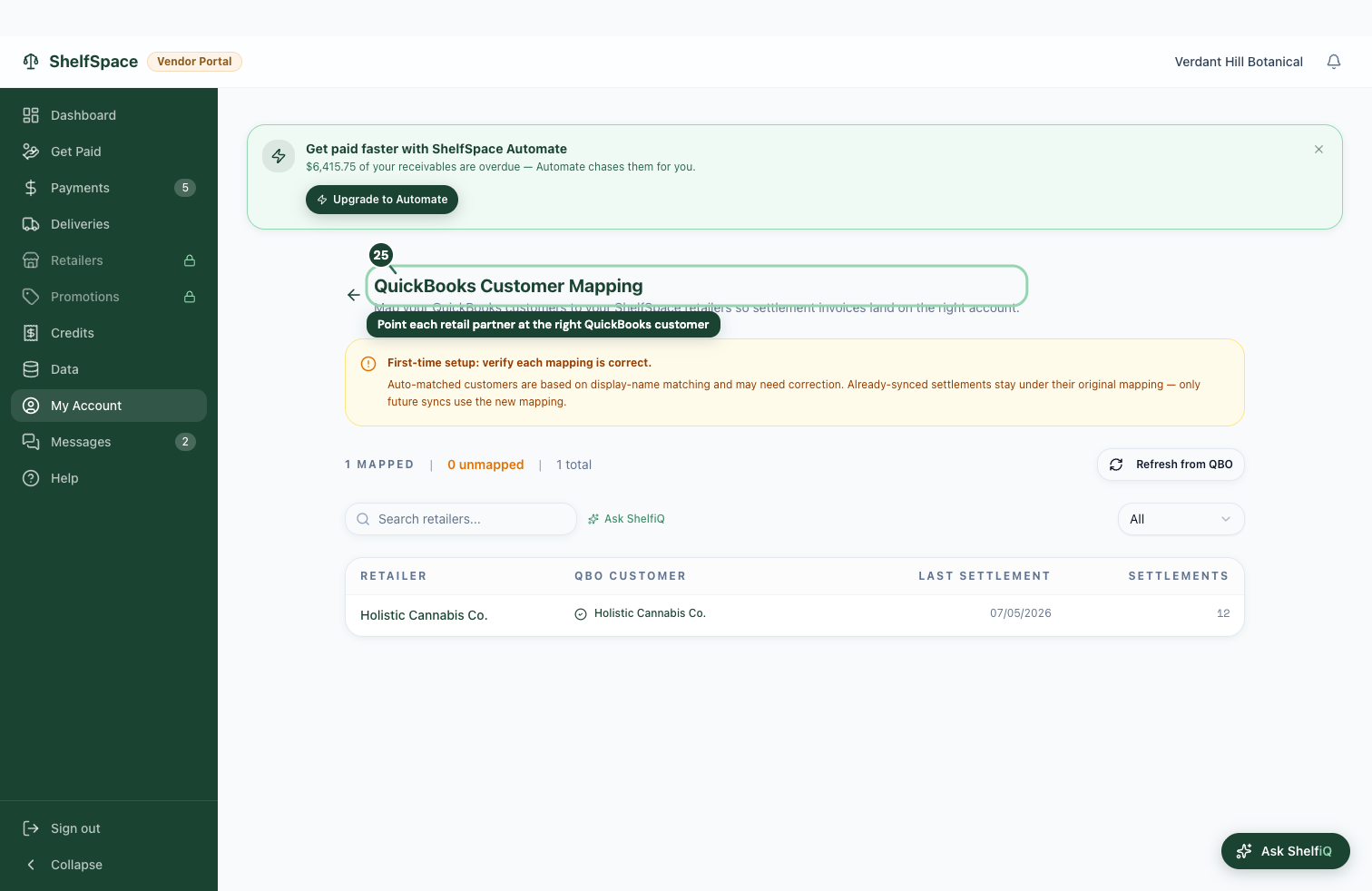
Point each retail partner at the right QuickBooks customer
26Point each retail partner at the right QuickBooks customer
Tell ShelfSpace which QuickBooks customer each of your retail partners is, and every settlement from that store posts to the right account in your books automatically. Each partner shows whether it's matched yet; pick the matching QuickBooks customer from the list to link it. Do it once per partner and it stays set. This appears once you've connected QuickBooks.
27

Match your products to QuickBooks items
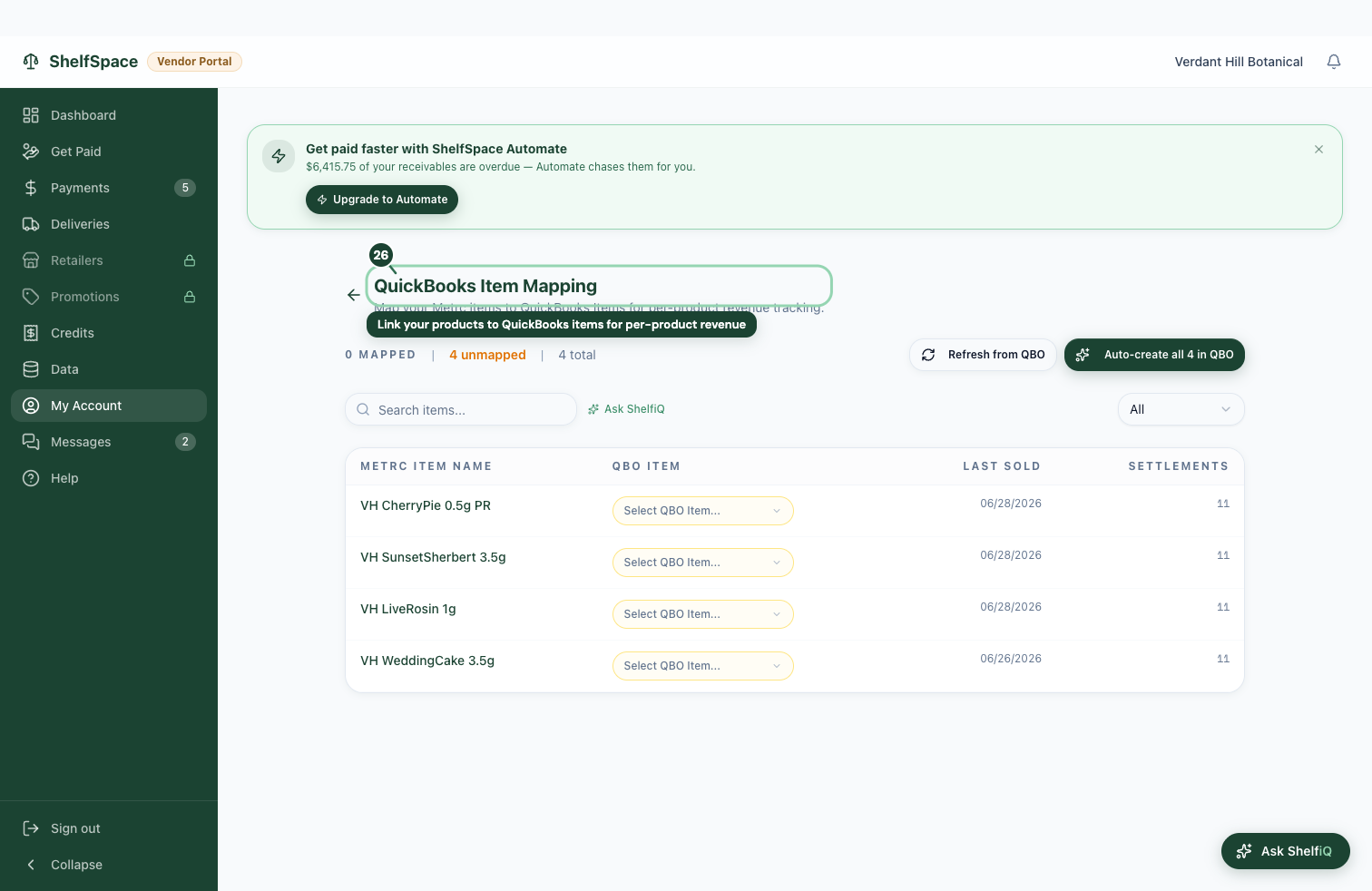
Link your products to QuickBooks items for per-product revenue
27Link your products to QuickBooks items for per-product revenue
Match your products to the items in your QuickBooks chart, and each sale posts as revenue against the right item -- so your books break down income by product, not one lump sum. Each product shows whether it's matched; pick its QuickBooks item to link it, or set one to skip. This appears once you've connected QuickBooks.